

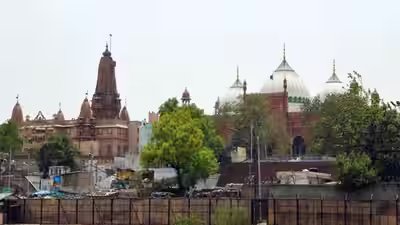

NEW DELHI: A compromise signed on October 12, 1968, was meant to settle a dispute over land in Mathura where the Lord Krishna Janmabhoomi temple and the Shahi Eidgah mosque stand today. It laid down boundaries, specified which portions were to be handed over to each side and sought to prevent future disputes over access and construction.Almost 58 years later, that agreement has emerged as one of the most consequential documents in the Krishna Janmabhoomi-Shahi Eidgah dispute. Hindu litigants contend that the organisation which entered into the settlement had no authority to compromise over property belonging to the deity. The Muslim side, meanwhile, has relied on the agreement and the civil court decrees that followed it to argue that the dispute had already been settled.The Allahabad high court has not delivered a final verdict on the validity of the 1968 compromise. On November 20, 2026, it dismissed an application seeking to declare the agreement “null and void” and cancel the decrees passed in 1973 and 1974. However, the court made it clear that the relief sought could not be decided through an interim application, as it was also the main relief in some connected suits and would require a trial.

From 1968 agreement to 2026 HC order: How the Mathura dispute unfolded
The dismissal, the court said, was without affecting the merits of the other suits. With the next hearing scheduled for December 10, the agreement remains at the centre of a dispute involving ownership, the authority of the parties who signed it and the legal protection available to places of worship.
What led to the 1968 compromise
The dispute concerns the Katra Keshav Dev complex in Mathura, with Hindu litigants claiming rights over a 13.37-acre property. The historical account of the site forms a significant part of the pleadings before the high court, though the claims about events centuries ago remain disputed.In its August 1, 2024 judgment, the Allahabad high court recorded the historical narrative advanced by the Hindu plaintiffs. According to their pleadings, a temple was built at the site in 1618 by Raja Veer Singh Bundela of Orchha. They alleged that Mughal ruler Aurangzeb partially demolished it in 1669-70 and raised a structure that came to be known as the Idgah mosque.The plaintiffs further stated that the British put 13.37 acres of land at Katra Keshav Dev up for public auction in 1815 and that Raja Patnimal of Benaras purchased it. His descendants later sold the property, with the transaction involving Seth Jugal Kishore Birla and the names of Pandit Madan Mohan Malaviya, Goswami Ganesh Dutt and Bhiken Lalji Aattrey appearing in the land’s subsequent history.The 2024 judgment also refers to a trust deed dated March 9, 1951, through which the entire 13.37-acre property was dedicated to the Shri Krishna Janmabhoomi Trust. The document stated that one of the trust’s objectives was to construct a temple at the birthplace of Lord Krishna.A key distinction in the present dispute is between this trust and the Shri Krishna Janmasthan Seva Sangh, the organisation that later entered into the 1968 compromise. The Hindu plaintiffs argue that the two were separate legal entities and that the Seva Sangh neither owned the property nor had the authority to enter into an agreement affecting the deity’s rights.
What did the agreement provide
The 1968 settlement arose from Civil Suit No. 43 of 1967, filed by the Shri Krishna Janmasthan Seva Sangh against the Trust Shahi Masjid Idgah and others. The dispute also involved Muslim residents, including people described in the court record as Ghosis and other inhabitants who claimed to be tenants or licensees.The Allahabad high court’s 2024 judgment records that the Idgah Trust had obtained permission from the Waqf Board through a letter dated September 9, 1968. A meeting held on October 8 that year adopted the agreement and authorised representatives to act on its behalf.The compromise was signed on October 12, 1968, presented before the court on October 17 and registered on November 22, according to the court record. The suit was eventually decreed on the basis of the compromise on July 20, 1973. A further decree followed on November 7, 1974.The agreement was not simply a broad understanding that both religious structures could continue to exist. It laid down specific arrangements for the land and physical boundaries between the two sides.Among other provisions, it required the northern and southern walls of the Idgah’s “Kachchi Kursi” to be extended eastwards towards the railway line. The Idgah Trust was to get certain Muslim inhabitants living outside those walls vacated and hand over possession of the land to the Seva Sangh.It also dealt with land around the Idgah, including a portion on its western-northern side. The agreement provided for the removal of rubble from steps on the southern side, after which the Seva Sangh would take possession of the land.There were restrictions on construction facing the other side. The Trust was not to install doors, windows or grills in walls facing the Seva Sangh, or open drains or water outlets in that direction. The Seva Sangh was bound by similar restrictions. It was to divert water from the Idgah’s outlets through pipes and construct a masonry drain at its own cost.The agreement further provided that both sides would file compromise applications in their pending cases after fulfilling the stipulated conditions. Either side could approach a court in the event of non-compliance.In effect, the document attempted to settle disputes over possession and the use of adjoining portions through a defined physical arrangement. It is this settlement, and whether the parties who signed it had the legal authority to do so, that is now being contested.
Why is the agreement being challenged
The challenge rests substantially on the distinction between the Shri Krishna Janmabhoomi Trust and the Seva Sangh.The Hindu plaintiffs argue that the property had been vested in the Janmabhoomi Trust through the 1951 trust deed, while the Seva Sangh was a separate organisation. According to their pleadings, the Seva Sangh had no ownership rights and could not enter into a compromise affecting the interests of the deity.They also contend that neither the deity nor the Janmabhoomi Trust was a party to Civil Suit No. 43 of 1967 or the subsequent settlement. The plaintiffs argue that the Seva Sangh represented itself as having authority over the property and conceded land that it had no right to surrender.

Sangh vs Trust: The legal distinction at the heart of the Mathura dispute
Advocate Kanu Agarwal told TOI, “The deity or the trust were never the parties to the Civil Suit No. 43 of 1967 or to the compromise deed dated 12.10.1968.” He said the Seva Sangh was a distinct legal entity from the Janmabhoomi Trust and “prima facie was not the owner of the suit property”.The 2024 high court judgment records these arguments, including the plaintiffs’ claim that the compromise was fraudulent and that the decrees based on it should not bind the deity or devotees.The defendants have contested this position. The court record notes the argument that the compromise was entered into by recognised representatives, with the Idgah Trust having obtained the Waqf Board’s permission. The Muslim side has also relied on the subsequent civil court decrees and argued that a challenge to the settlement cannot be brought through fresh proceedings.The central legal question, therefore, is whether the Seva Sangh had the authority to enter into the compromise, whether the settlement could bind the deity and the trust, and what legal effect should be given to the civil court decrees.
How the dispute returned to court
The current round of litigation gained momentum in 2020, when a suit was filed by advocate Ranjana Agnihotri and six others on behalf of the deity and devotees. The plaintiffs sought ownership of the 13.37-acre property, removal of the Shahi Eidgah structure and restoration of the temple.The suit challenged the 1968 compromise and the decrees passed in 1973 and 1974, arguing that the settlement could not extinguish the rights of the deity because neither the deity nor the Janmabhoomi Trust was a party to the original proceedings.The issue soon became part of a wider legal and political debate around the Places of Worship (Special Provisions) Act, 1991, which bars conversion of the religious character of a place of worship as it existed on August 15, 1947, subject to the Act’s provisions and exceptions.On the Places of Worship Act, Advocate Kanu Agarwal said, “The compromise deed of 1968 has no bearing or connection with Places of Worship Act.”He added while talking to TOI that the site’s religious character and title “would require detailed trial wherein evidence is led by the parties”.In May 2022, AIMIM supremo Asaduddin Owaisi questioned the revival of the dispute, referring to the 1968 settlement. “Sri Krishna Janmasthan Seva Sangh and the Shahi Idgah Trust had resolved their issues by an agreement in 1968,” he tweeted, adding, “Why revive it now?” Owaisi also invoked the Places of Worship Act.

What Owaisi said about the 1968 Mathura agreement
The Hindu side, however, maintained that the agreement was not binding on the deity and that its validity needed to be examined by a court.
What the HC has said so far
On August 1, 2024, the Allahabad high court rejected applications filed by the Muslim side seeking dismissal of the Hindu worshippers’ suits at the threshold under Order VII Rule 11 of the Code of Civil Procedure.The court held that the suits could proceed and were not barred at that stage by the Places of Worship Act, the Waqf Act or the Limitation Act. This was a ruling on maintainability, not a final decision on ownership of the property or the validity of the 1968 agreement.The judgment examined arguments over the trust deed, the identity of the Seva Sangh, the original suit and the compromise. It observed that questions concerning the legality and validity of the agreement were factual issues that would require evidence during trial.The court’s observations did not settle the dispute over title. Instead, they allowed the suits to move forward so that the competing claims could be examined through the judicial process.The litigation also moved to the question of a survey of the disputed premises. In December 2023, the high court had allowed an application seeking a court-monitored inspection. The Supreme Court stayed the implementation of that order in January 2024 in Special Leave Petition No. 481/2024.The survey issue remains linked to the Supreme Court proceedings. On November 21 that the high court had said it could not pass a fresh order on a similar survey application until the Supreme Court finally adjudicated the pending petition.
November 20 order: No final ruling on the 1968 settlement
The latest development has again brought the compromise into focus.In an order dated November 20, 2026, Justice Avnish Saxena dealt with four applications in Original Suit No. 7 of 2023. One of them, Application No. 56Ga2, sought a declaration that the October 12, 1968 agreement was null and void, cancellation of the 1973 and 1974 decrees and delivery of vacant possession of the disputed premises to the deity.The court noted that the suit was among 18 matters concerning the same property. Since the relief sought through the application was also the principal relief in some connected suits, it said the issue could not be adjudicated without a trial.
Share your thoughts in the comments
Be respectful · TOI community guidelines
The application was dismissed, but the order expressly stated that this was without affecting the merits of the other suits and that the application had not been taken up on its merits.In other words, the high court did not uphold the 1968 agreement or declare it invalid through this order. The question remains open for adjudication in the connected proceedings.The high court also dealt with applications concerning the representation of the deity and the impleadment of additional parties. It dismissed a plea seeking to implead descendants of Thakur Keshav Dev, observing that the deity was already represented through a next friend and that the purpose of adding the applicants had not been adequately explained.The next hearing in the dispute is scheduled for December 10.
Discover more from updatview
Subscribe to get the latest posts sent to your email.