


NEW DELHI: Along the narrow lanes leading to a crumbling haveli in Said-ul-Ajaib, artists are painting scenes and familiar features from the neighbourhood on the walls.Old doorways and architectural details sit alongside illustrations of a tree, a water structure, people and cattle, as well as colourful depictions of everyday life. The paintings, based on photographs taken in and around the neighbourhood, are part of an exhibition that will explore Said-ul-Ajaib’s history and heritage.

The artwork portrays the village’s transition from its historical roots to modern developments (Photo credit: Anushka Kogta)
Titled Sanjha Said-ul-Ajaib—with sanjha meaning ‘ours’- the exhibition is organised by students of Dr BR Ambedkar University Delhi as part of their Urban Studies Studio course.Led by assistant professor Dr Shekhar Tokas and associate professor Dr Nidhi Tewathia, the students have documented the village through five themes: history, heritage, culture, disaster and risk and gully intervention. Their work also covers gender, economy, and changing livelihoods through photographs, maps, paintings and interviews.For Tokas, the idea is to bring Delhi’s villages into discussions about the city’s history. While Delhi is known for its monuments and seven historical cities, its villages rarely get the same attention. “These are villages older than Delhi, and they have a contribution,” he says.

The initiative is aimed at fostering a sense of belonging among residents regarding their cultural heritage (Photo credit: Anushka Kogta)
Over the years, Said-ul-Ajaib’s landscape has changed considerably.Sanjay Tewatia, 53, whose amily has lived here for seven or eight generations, remembers a very different place. “Earlier, there were only 30-40 houses. There were fields and a forest. We used to play in the fields. There were date palms and mango trees,” he recalls.

Local artists use photographs to paint familiar scenes on walls in the neighborhood (Photo credit: Anushka Kogta)
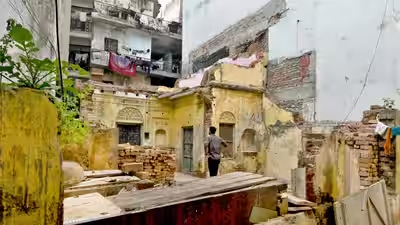
Today, multi-storey buildings stand in their place, and two of the three old havelis he remembers have been torn down.One of the remaining old structures, a haveli has been chosen as the exhibition venue. The building has been left largely in its existing condition, rather than being extensively renovated.Atishay Khanna, who is leading the design intervention at Said-ul-Ajaib, says that holding the show in an old structure surrounded by apartments reminds people of the village’s roots. The idea, he says, is to create a sense of belonging and encourage residents to take ownership of the spaces they inhabit.The work in the lanes is another part of this effort.

Students from Dr BR Ambedkar University Delhi are creating an exhibition to showcase the history of Said-ul-Ajaib (Photo credit: Anushka Kogta)
Suhani, 23, is using white cement and paint to recreate photographs taken around Said-ul-Ajaib. The paintings include familiar landmarks as well as details of older architecture.“We took pictures and then drew them here. We want to show the transition from historical times to modern times,” she says.
Discover more from updatview
Subscribe to get the latest posts sent to your email.