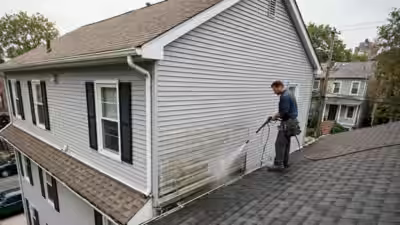

A New York landlord has been held liable after a worker fell from the roof of a rental property while cleaning its exterior siding, even though he had left his personal safety harness at home. An appeals court ruled that the property owner was responsible for providing proper fall protection and could not avoid liability by blaming the worker’s decision to proceed without his own equipment.The ruling was upheld by the Appellate Division of the New York State Supreme Court, which affirmed an earlier decision granting partial summary judgment to the injured worker, Benjamin E. Irwin, under the state’s Labor Law Section 240(1).Irwin was cleaning vinyl siding on a rental building owned by the defendant when he fell from its roof. He was not using any safety equipment at the time of the accident.The landlord challenged the liability ruling, arguing that the work amounted to routine maintenance and therefore did not qualify for protection under the state law. He also maintained that Irwin’s own actions were responsible for the accident because he had left his personal safety harness at home.The appeals court rejected both arguments, finding that the cleaning work involved risks similar to those encountered at construction sites and fell within the protection offered by Section 240(1).
Why the court held the landlord responsible
Under New York’s Labor Law Section 240(1), property owners and contractors must provide appropriate safety equipment to protect workers undertaking jobs involving elevation-related hazards.The court noted that although ordinary household window cleaning is generally excluded from the law, other cleaning activities can qualify when they involve comparable risks to construction work.Referring to an earlier ruling in Soto v J. Crew Inc., the judges said cleaning projects must be assessed according to their circumstances, rather than automatically being classified as routine maintenance.In Irwin’s case, the court found that the landlord had failed to provide any safety devices despite the risk involved in working at height. It also noted that the property contained at least three rental units, making the owner subject to the statutory safety obligations.The judges said the landlord could not transfer that responsibility to the worker simply because he had chosen to use his own equipment.They also rejected the argument that Irwin should have cleaned the difficult-to-reach sections from second-floor windows instead of climbing onto the roof.The court explained that choosing one method of completing a job over another, even when a safer alternative might have been available, amounts to comparative negligence. That alone does not remove an owner’s liability under Section 240(1).The judges found that this defence could not succeed because the landlord had not supplied any safety devices in the first place.
Landlord’s attempt to recover damages from worker rejected
The property owner also sought permission to amend his legal response to bring a counterclaim seeking common-law indemnification from Irwin. In effect, he wanted to recover compensation from the injured worker for the liability imposed on him.The appeals court rejected that request, finding that the proposed counterclaim lacked legal merit.The judges said allowing a property owner to recover damages from an injured worker on the basis of that worker’s alleged negligence would undermine the purpose of Section 240(1), which provides special protection to people working at elevated locations.The decision also referred to earlier cases establishing that a worker’s contributory negligence cannot be used as a defence against liability under the provision.The court unanimously affirmed the lower court’s September 18 last year order, which had granted Irwin partial summary judgment on liability and rejected the landlord’s request to pursue an indemnification claim.
Discover more from updatview
Subscribe to get the latest posts sent to your email.