




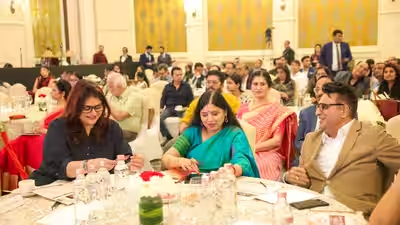

A love for books, a room full of ideas and coffee-fuelled conversations set the tone for an engaging afternoon. Co-presented by Delhi Times, Joy of Reading brought together authors, publishers and academicians to share perspectives, discuss the importance of reading and exchange thoughts from their respective fields.“At a time when our attention is increasingly fragmented, such initiatives like Joy of Reading remind us of the enduring power of the written word to inspire, connect and transform. Reading is not merely a habit, it is a lifelong love affair, one that continues to enrich us at every stage of life,” said Advaita Kala, screenwriter and author who led the storytelling session of the day.

Gul Panag, Sneha Misran, Advaita Kala
‘Reading is the surest antidote to propaganda’While each generation may approach books differently, the need to read remains unchanged. Author Bijayalaxmi Nanda, principal of Miranda House, DU, noted, “Young kids have a lot of information. What they really require is to be able to know, at least from our point of view, what are the books that helped us navigate our lives.”Bringing the voice of Gen Z, Kitaab Club co-founder Sneha Misran said, “In university and college spaces, reading was still about expanding horizons or developing vocabulary or really hoping that your crush will see you with a copy of The Metamorphosis. And then suddenly, the internet became available. I guess the most prominent shift we noticed was in how we chose books for our book club. What was earlier about personal expansion became more about signalling your politics and your aesthetics.”

Bijayalaxmi Nanda, Shubhra Saxena
“An author once told me that reading is the surest antidote to propaganda. So we all need to read books,” said Ajay Jain, author and founder of Kunzum Books.‘Young kids need attentive detox’For Dr Anupam Sibal, Group Medical Director of Apollo Hospitals, reading to young children is crucial to their cognitive development and ability to engage with the world. “There is enough evidence to show that when you read, the child doesn’t have to understand the spoken word. The child does not have to understand what you are saying. But the fact that a parent, a mom, is engaging with the child brings numerous advantages to the development of the brain. Young kids in today’s time need to go in for an attentive detox. When you see kids on the iPad, they focus on the short form comprehension,” he explains.Author Armaan Farid agrees, “As a writer, the onus is on me to create stories that young readers will pick up today and look back on tomorrow as the ones that got them into reading.”

Dr Anupam Sibal, Ajay Jain
‘The future is about creating more readers’“The future of reading is not about choosing between paper and screens, but about creating more readers.” That’s the takeaway for Ajay Mago, publisher of Om Books International. Discussing information consumption, Shubhra Saxena, author and IAS officer, added, “If you look at the world today, we have more information consumption but information consumption is not necessarily development of understanding. Now, if you don’t read, then that understanding doesn’t develop. You have merely consumed information. And because of the proliferation of mobile phones and a very affordable network, now we have 5G, people are watching all kinds of content online, getting bombarded with information, never getting a chance/time to reflect.”Arvind Chatterjee, digital creator, said, “Readers want to understand the book’s world so they can make the cinematic experience of movie adaptations more meaningful and immersive. I think that’s great because it encourages people to pursue stories.”

Ajay Mago, Arvind Chatterjee, Armaan Farid
Discover more from updatview
Subscribe to get the latest posts sent to your email.