





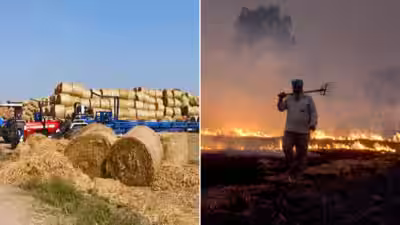

On October 23, Surjeet harvested paddy across eight acres in Atta village in Haryana’s Panipat district. Four days later, without burning a single stalk of stubble, his entire field had been cleared of parali (paddy residue) and was ready for the sowing of winter wheat.Private tractor-baler operators had arrived on his land, cut and dried the straw, compressed it into neat rectangular bundles and hauled it away to industrial buyers, all without charging Surjeet a rupee.Weeks later, the Haryana government’s direct benefit transfer of Rs 1,200 per acre for managing crop residue without burning was on its way to his bank account.“There is no problem now,” says Surjeet. “In our village of around 10,000 to 15,000 people, I don’t think there is anyone left who still burns parali. If the field gets emptied in three or four days, there is no issue at all.”Yet, several hundred kilometres northwest, across the state border in Punjab, and in dozens of agricultural hotspots across the Indo-Gangetic Plain, autumn skies told a different story during the 2026 harvest season.Despite thousands of crores invested in subsidies, satellite monitoring and enforcement, farm fires persisted in 2026, official data show.Ground interviews with farmers and machine operators across Haryana and Punjab, examined alongside parliamentary records and assessments by the Commission for Air Quality Management (CAQM), reveal a more complex picture. Government subsidies have helped create a commercial ecosystem of private baling entrepreneurs, but access to the machinery and its services remains uneven, particularly for small and marginal farmers.
Official scorecard: Who still burns stubble
Over a nine-year period, official data presented in Parliament point to a sharp decline in agricultural fires.Between the 2017 and 2025 Kharif seasons, active fire counts fell by 92.4 per cent in Punjab, from 67,079 incidents to 5,114, and by 94.9 per cent in Haryana, from 13,085 to 662.However, the 2026 harvest season disrupted that downward trend in Punjab, according to data compiled by CAQM and the Punjab Pollution Control Board (PPCB).By late November 2026, Punjab had recorded 6,874 stubble-burning incidents, exceeding its entire 2025 tally. Fires were concentrated in districts such as Ferozepur, Amritsar, Tarn Taran and Patiala.Haryana, by contrast, recorded 214 incidents during CAQM’s mid-November review period.To understand why the two states have seen different outcomes, it is important to examine the economics and logistics of crop-residue management.Following Supreme Court scrutiny, the Union environment ministry doubled the environmental compensation for stubble-burning incidents in November 2024. The fines vary according to the size of a farmer’s landholding:
- Less than two acres: Rs 5,000
- Two to five acres: Rs 10,000
- More than five acres: Rs 30,000
In May 2025, CAQM issued Direction No. 90, explicitly asking Punjab and Haryana to ensure that crop-residue management (CRM) machines were available to small and marginal farmers without rental charges.
Pre-poll politics heats up over smoke and blame
With Punjab heading towards assembly elections in early 2027, stubble burning has become more than an environmental issue. It is also a political flashpoint.The tensions were visible around Diwali in early November 2026.Delhi minister and BJP leader Kapil Mishra pointed to a sharp rise in Punjab’s farm fires on Diwali night, calling the spike “suspicious” and demanding an investigation into what he described as a conspiracy.Punjab’s leadership pushed back, accusing the BJP of using Delhi’s smog to portray Punjabi farmers in a negative light ahead of the elections.Chief minister Bhagwant Mann argued that paddy is also grown in Uttar Pradesh, Haryana and even Lahore. He questioned why smoke from Punjab was being blamed for pollution in specific parts of Delhi while neighbouring areas were being treated differently.Later in the month, AAP chief Arvind Kejriwal cited remarks by Union agriculture minister Shivraj Singh Chouhan, who had earlier praised the broader decline in farm fires in Punjab. Kejriwal argued that even the Centre’s own agriculture minister had acknowledged farmers’ efforts, while political opponents continued to blame them.
The zero-cost clearance ecosystem
Ground reports suggest that where farmers are connected to private operators and industrial buyers, stubble burning has become far less common, without the need for coercive enforcement.In Atta village in Panipat, Surjeet recalls that farmers routinely burned paddy residue three to four years ago because they had few alternatives and feared that straw left on the fields would obstruct wheat germination.“Earlier, we were forced to burn the parali because it stayed on the soil and the seeds wouldn’t grow properly,” he says. “Now we have facilities. Private tractor operators come, cut the straw, let it dry for two to three days, make bundles and take it away for their own benefit.”Industrial boilers, brick kilns, which have been directed under CAQM Direction No. 92 to co-fire paddy-straw pellets, and compressed biogas (CBG) plants buy baled straw. This demand allows private operators to clear Surjeet’s eight-acre field without charging him.Surjeet, along with 10 lakh other farmers, has also registered his crop on Haryana’s Meri Fasal Mera Byora portal to claim the state’s Rs 1,200-per-acre Parali Protsahan incentive.“The money comes directly into the account, though it takes three to four months,” he says.A similar private-sector model is taking root in parts of Punjab, though with an unexpected cross-border dimension.A farmer from Punjab, who spoke on condition of anonymity because of sensitivities involving local farm unions, said his village had faced a severe shortage of machinery two years ago, leaving farmers with little choice but to burn the residue.“Two years ago, how could limited machinery clear four or five entire villages?” he says. “Today, there are two or three machines operating in every village. Why would any farmer set fire to his field when his parali is being lifted for free?”According to him, private operators, many of them travelling from Haryana, now serve farmers across two or three villages at a time. They lease common collection grounds to stack thousands of compressed bales before transporting them to factories.He says the service is available to both large landowners and small farmers in his village. “We just call the machine owner when our field is ready, and he clears small and big plots alike for zero money. We only have to run our own tractor once to cut the standing stubble.”
Why subsidised machines haven’t reached smallholders
If private operators are clearing fields for free in villages such as Surjeet’s, why are thousands of farmers still risking fines of up to Rs 30,000 and possible criminal proceedings by burning their fields?Farmer testimonies, examined alongside surveys by the Council on Energy, Environment and Water (CEEW) and the Rajiv Gandhi Institute for Contemporary Studies (RGICS), point to four structural bottlenecks that prevent government subsidies from translating into accessible machinery services for small farmers.
The unforgiving 10-day window
Paddy farmers in northern India face a narrow window between harvesting Kharif rice in late October and sowing Rabi wheat in November.“When we harvest paddy, we have a strict window of 10 days to lift the parali and sow wheat,” the Punjab farmer explains. “If the straw is not cleared within 10 days, the residual moisture in the soil evaporates. Once the soil dries out, you have to flood-irrigate the field again and wait another 15 to 20 days for it to dry enough for sowing. That pushes sowing into December’s cold weather, and wheat yields drop sharply.”Surjeet points out that farmers growing short-duration paddy varieties such as Pusa 1509 have a more comfortable 45-day gap before wheat sowing, while those growing late-maturing varieties have little margin for delay.When private balers fail to arrive within the critical 10-day window, farmers may resort to burning the residue to prepare their fields in time for the next crop.
The capital trap: Subsidised balers, missing tractors
Under the Central Sector CRM scheme, individual farmers are eligible for a 50 per cent subsidy on crop-residue management machines. Custom Hiring Centres (CHCs), cooperative societies and rural entrepreneurs are eligible for an 80 per cent subsidy.On paper, more than 2.71 lakh machines have been distributed across Punjab and Haryana combined.On the ground, however, small and marginal farmers often struggle to afford the equipment or get it deployed on their plots. They account for more than half of Haryana’s 16.16 lakh operational landholdings, with over eight lakh holdings measuring less than one hectare. Punjab has 10.92 lakh operational holdings.“We had sown in one acre,” says Pankaj, whose family owns an acre of land in Atta village, Haryana.He points out that while small holdings are common in Haryana and Punjab, deploying machinery on small plots can be economically unviable.“Since the process requires three different machines to work on the field, it becomes an inefficient deal for the big farmers on small pieces of land,” he says.The Punjab farmer makes a similar point. Even with a government subsidy for a baler, operating a viable baling unit requires eight to 10 tractors, trolleys, rakes and a full team of daily-wage workers. The total investment can run to Rs 1.5 crore to Rs 2 crore, turning it into a commercial enterprise rather than an affordable option for an individual smallholder.Another farmer in Haryana has faced a similar capital barrier. He bought commercial baling machinery two years ago, anticipating demand after the government ban on stubble burning. Despite applying for a subsidy, his application was never approved, forcing him to invest Rs 40 lakh of his own money in two balers.“To run those machines and cover 25 to 30 acres a day, you need four tractors running simultaneously, plus diesel and hired labour costing Rs 3,000 to Rs 4,000 every day,” he says.Producing roughly 1,200 bales in a season, he operates on thin margins, earning a profit of 5 to 7 per cent per bundle sold to factories.
Machine hoarding, high rentals and subsidy delays
Independent research suggests that subsidised machines remain concentrated among relatively wealthy farmers and private aggregators, limiting access for smallholders.An RGICS field survey found that only 8 per cent of individual farmers who purchased subsidised CRM machines rented them out to neighbouring farmers. While awareness of the scheme was nearly universal, actual adoption stood at 35 per cent, and only 14 per cent of beneficiaries reported being satisfied.A CEEW survey of 1,478 farmers across 11 Punjab districts found that 63 per cent of farmers using in-situ CRM machines had to rent them rather than own them.Of those renting machines, 82 per cent borrowed equipment informally from fellow farmers or relatives. Only 3 per cent accessed machines through government-funded Custom Hiring Centres, while 12 per cent used cooperative societies.RGICS found that high rental costs, combined with the need for tractors with engines of at least 50 horsepower, which many small farmers do not own, pushed 13 per cent of adopters who had stopped using the machines back towards stubble burning the following year.CEEW also found that nearly half of the farmers using CRM machines continued to burn loose straw partially before using the machines, to reduce diesel consumption and operating costs.Subsidy delays add to the problem. RGICS found that farmers who purchased subsidised machinery waited an average of 40 to 45 days after inspection for reimbursements to reach their bank accounts.
Market opacity and lack of government outreach
Even farmers willing to invest in baling machinery face a major hurdle: a lack of institutional support and reliable information about where to sell the collected straw.In Atta village, Surjeet estimates that at least five to seven tractor-baler units are needed to ensure timely clearance of fields across the village. He wants to buy a baler himself but is hesitant because he has little information about market linkages.“I would definitely think of buying a machine if there is a profit in it,” he says. “Right now, I don’t know where the operators sell these bales or what rates factories pay. The government subsidises the machine, but no official comes to tell us how the supply chain works or where to sell the bundles. Only those who already have family connections in the business know how to run it.”
Share your thoughts in the comments
Be respectful · TOI community guidelines
Bridging the last mile
Seven years and more than Rs 4,200 crore into the crop-residue management mission, experiences from Panipat and Punjab show that stubble burning is not an inevitable part of farming. When private operators have enough tractors, assured industrial buyers and designated collection centres, farmers such as Surjeet are willing to stop burning residue.But subsidies for individual machines alone are not enough.The next step is to invest in village-level logistics, ensure small farmers can access machinery during the critical 10-day sowing window and establish transparent, block-level biomass procurement centres. These could help bridge the gap between subsidised machinery and the farmers who need it most.
Discover more from updatview
Subscribe to get the latest posts sent to your email.