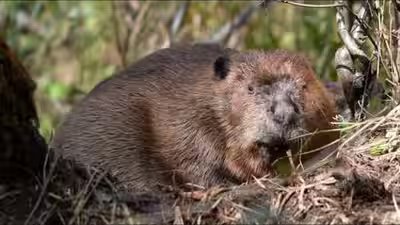

Who knew one animal could change an entire landscape?Beavers in an English estate did not hold meetings about biodiversity, draw up restoration blueprints or worry about water quality. They simply got to work, felling trees, building dams and creating homes around the waterways they inhabit.A recent study in England by University of Liverpool has found that reintroducing beavers to an estate in Essex transformed the surrounding stream in just a year. Researchers recorded an increase in terrestrial insects, higher oxygen levels in the water and a striking reduction in nitrate concentrations downstream. Some of these changes could be detected at least a kilometre away from the beavers’ dams.The findings offer another reason to reconsider an animal that was once hunted out of Britain. They also demonstrate how restoring a species can have consequences that extend well beyond the animal itself.
A landscape shaped by its inhabitants
The animals in question are Eurasian beavers (Castor fiber), a species native to Britain that had been hunted to extinction in England around 400 years ago. Their thick fur, meat and castoreum, a substance produced by their scent glands and historically used in perfumes and medicines, made them valuable to hunters. But removing beavers also meant removing an important part of the country’s natural ecosystem.Beavers are often described as ecosystem engineers. Unlike animals that simply adapt to their surroundings, they actively change them. They fell trees with their powerful front teeth, construct dams using branches, mud and vegetation, and create ponds that allow them to move through water more safely. These structures slow the movement of streams, allowing water to spread into surrounding areas and form wetlands.What might look like a rather inconvenient obstruction to a flowing stream can become an entirely new habitat for wildlife. Ponds, muddy banks, fallen trees and waterlogged vegetation offer different living conditions for insects, amphibians, birds and aquatic organisms. Even the trees felled by beavers have a second purpose, providing deadwood that supports insects and fungi.It is this ability to change the conditions around them that makes beavers particularly interesting to conservationists. Rather than simply introducing another species into an ecosystem, bringing back beavers can help restore some of the natural processes that disappeared alongside them.
What happened at Spains Hall Estate?
Researchers from the University of Oxford and the University of Essex, including Oliver John Sworder and Michelle Jackson, studied the effects of reintroducing beavers to enclosures at Spains Hall Estate in Essex.The team collected information about the stream’s water quality, algae and invertebrate populations for a year before the beavers arrived in 2023. They then repeated their observations a year after the animals had been introduced. This before-and-after approach offered an opportunity to examine how the ecosystem changed following the reintroduction, rather than relying solely on comparisons between different streams.The findings, published alongside an openly accessible dataset on Dryad on November 3, 2026, showed that the changes were not limited to the immediate area around the dams. One of the most noticeable differences was the increase in terrestrial invertebrates, both in their abundance and species richness. In simpler terms, there were more land-dwelling invertebrates, and researchers recorded a greater variety of them.Insects and other small invertebrates are essential to the functioning of ecosystems. They pollinate plants, break down organic matter, recycle nutrients and provide food for birds, fish, amphibians and other animals. An increase in their numbers can therefore have consequences that travel up the food chain.The researchers also examined freshwater invertebrates, but the findings here were more complicated. There was no statistically significant increase in overall freshwater invertebrate richness, abundance or biomass. However, certain indicator groups were affected, and the composition of feeding groups within the stream changed. In other words, the beavers did not simply make every category of aquatic insect more plentiful. They altered the conditions in which different organisms lived and fed.
The surprising effect on water quality
Perhaps the most striking finding concerned the water itself. Researchers recorded an increase in dissolved oxygen throughout the stream following the beavers’ arrival. Dissolved oxygen is exactly what it sounds like: oxygen present in water, which aquatic organisms rely on to survive. Fish, insect larvae and other freshwater animals need sufficient oxygen to carry out essential biological processes. When oxygen levels fall too low, aquatic ecosystems can become difficult places to survive.The researchers also examined nitrate concentrations, which offered another interesting result. Nitrate is a naturally occurring form of nitrogen, but excessive amounts entering waterways can become a serious environmental problem. Agricultural fertilisers, animal waste and other sources can introduce additional nitrogen into streams and rivers. When concentrations become too high, they can encourage excessive algae growth. As this algae dies and decomposes, microorganisms consume oxygen in the process, potentially leaving less available for other aquatic life.Here, the researchers noticed something rather unexpected. Nitrate concentrations increased in the water around the beaver dams, but downstream, the nitrate was almost completely filtered out following the reintroduction.Beaver dams can slow water movement, allowing sediment and organic material to settle rather than being carried further downstream. The wetlands they create can also encourage biological processes through which nitrogen is absorbed by vegetation or converted into nitrogen gas by microorganisms. These processes can help remove excess nitrogen from waterways.Although the study does not establish that one particular mechanism was responsible for the changes, the results suggest that beaver activity can influence how nutrients move through an ecosystem.Even more interestingly, the effects were not confined to the immediate surroundings of the dams. Researchers found that the changes extended at least a kilometre downstream. This suggests that the ecological benefits of beaver activity can travel considerably further than the structures the animals build.
A little more room for nature
The findings arrive at an interesting time for conservation in Britain. After centuries of absence, beavers are gradually returning to English waterways through managed reintroduction programmes and the expansion of existing populations.In February 2025, the British government announced that wild releases of beavers in England would be permitted under licences issued by Natural England. The decision marked an important step towards restoring a species that once played a natural role in shaping the country’s rivers and wetlands.However, bringing back beavers is not without its complications. Their dams can cause localised flooding, affect agricultural land and change the availability of habitats for certain species. Watercourses do not exist in isolation from people, and the interests of farmers, landowners and nearby communities must be considered when deciding where reintroductions should take place. The benefits also depend on the characteristics of individual landscapes, so what works in one location may not necessarily work in another.There is also an important distinction to make about the latest research. The observations were collected over a relatively short period of one year, at a managed estate. They offer encouraging evidence of how quickly ecological changes can begin, but longer-term monitoring will be needed to understand whether these improvements persist and how they develop over time.Still, the study makes a compelling case for looking at conservation differently. Protecting an ecosystem does not always mean intervening in every little detail. Sometimes, it means bringing back the species that already know how to look after it.Beavers build dams because they need deeper water and safer places to live. They fell trees because they need food and building materials. Yet, in meeting their own needs, they create habitats for countless other organisms, alter the movement of water and influence the nutrients flowing through it.A year after their arrival, the stream at Spains Hall Estate was already showing signs of these changes. There were more land-dwelling invertebrates, higher oxygen levels and considerably less nitrate downstream.Perhaps the most encouraging part is that the beavers were not introduced to perform any of these individual tasks. They were simply given a place to live and allowed to do what comes naturally. Sometimes, nature’s most effective restoration workers are already there.
Discover more from updatview
Subscribe to get the latest posts sent to your email.