




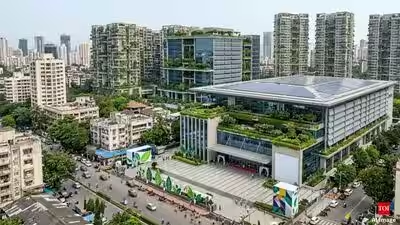

MUMBAI: As Mumbai battles rising temperatures, escalating cooling requirements, water stress and mounting pressure on its urban infrastructure, Maharashtra has emerged as India’s biggest green building market, accounting for nearly 30% of the country’s registered green building footprint.The Mumbai region alone has 2,057 registered projects spread across 2.19 billion sq ft, according to figures released by the Confederation of Indian Industry’s (CII) Indian Green Building Council (IGBC) on Thursday.The numbers highlight the growing scale of sustainable construction in the state, but also raise a larger question for Mumbai: can the green building movement move beyond premium commercial developments and new projects to encompass thousands of existing residential buildings, housing societies and redevelopment projects?For residents, the implications go beyond environmental credentials. Energy-efficient building designs, better insulation, natural lighting and ventilation, efficient air-conditioning systems, rainwater management and wastewater recycling can potentially reduce electricity and water consumption, lower maintenance costs and improve indoor living conditions.These benefits could become increasingly significant as households face higher cooling requirements and pressure on civic water resources.Maharashtra has 4,754 IGBC-registered projects covering 5.01 billion sq ft, placing it well ahead of Uttar Pradesh, which ranks second with 1,777 projects and 1.90 billion sq ft. Gujarat, Karnataka and Tamil Nadu occupy the next three positions.Maharashtra accounts for approximately 23% of India’s registered projects and 30% of its registered green building footprint.Nationally, India has 20,621 IGBC-registered projects covering 16.55 billion sq ft. Of these, 8,600 buildings, covering 5.24 billion sq ft, have been certified. India is currently the world’s second-largest green building market, according to IGBC.The potential resource savings are substantial. IGBC estimates that its rated buildings save approximately 64 billion units of electricity and 199 billion litres of water annually, while avoiding around 53 million tonnes of carbon dioxide emissions every year.“India’s green building movement has evolved from an emerging idea into a nationwide transformation over the last 25 years. As India faces rising temperatures and growing cooling requirements, buildings must become a central part of the solution to climate risk and energy security,” said C Shekar Reddy, national chairman, CII-IGBC, and chairman of Green Building Congress 2026.
Commercial buildings dominate
Interestingly, commercial developments account for the largest share of India’s registered green building projects. Of the 20,621 projects, 11,991 (58.1%) are commercial buildings, while residential projects account for 5,775 (28%).Transit infrastructure contributes 1,342 projects (6.5%), followed by industrial and logistics facilities with 1,022 projects (5%).The relatively smaller residential share highlights the scope for expanding green building practices across the housing sector, particularly in a city such as Mumbai, where redevelopment, vertical growth and large-scale residential construction are transforming the urban landscape.IGBC has 33 green and net-zero rating systems covering residential, commercial, industrial, institutional and infrastructure projects. Its framework also includes systems for affordable housing and smaller developments.
Maharashtra offers construction incentives
The state has introduced policy measures to encourage developers to adopt green building standards. The Pune Municipal Corporation and Pune Metropolitan Region Development Authority offer additional floor space index (FSI) of 3%, 5% and 7% for buildings securing IGBC Silver, Gold and Platinum ratings, respectively.The Maharashtra public works department has mandated that renovation of existing government buildings and construction of all new government buildings follow the appropriate IGBC green building rating system.The updated Unified Development Control and Promotion Regulations (UDCPR) 2020 also mandate at least an IGBC Silver rating for buildings in integrated township projects.The state is drafting Energy Conservation Building Code (ECBC) Rules 2025 to establish standardised energy performance requirements for new commercial buildings.Among the prominent projects in Maharashtra associated with the green building movement are the RBI Central Office Building, Bombay House, Chhatrapati Shivaji Maharaj Vastu Sangrahalaya, Chhatrapati Shivaji Maharaj Terminus, Mumbai International Airport and Mumbai Central railway station. Other projects include Suzlon One Earth and the Infosys Pune campus, recognised as a pioneering net-zero energy campus.
Green finance could make sustainable homes affordable
A major focus of the forthcoming Green Building Congress will be the role of finance in making sustainable construction more accessible. IGBC plans to bring financial institutions, housing finance companies, developers and investors together to explore preferential interest rates for certified green projects, green home loans, green mortgages, green bonds and ESG-linked investments.For prospective homebuyers, the availability of green home loans and preferential financing could make energy-efficient housing more attractive. However, the actual benefit would depend on the additional construction cost, loan terms and demonstrable savings in electricity, water and maintenance expenses.“Access to affordable financing remains an important enabler for wider adoption. Innovative financing models and financial incentives can help bridge the gap between initial investment and long-term operational savings,” IGBC said.The next phase of the movement will also focus on retrofitting existing buildings, integrating renewable energy, adopting smart building management systems and using low-carbon construction materials.More than 350 organisations in the building sector have committed to achieving net-zero status for their new and existing buildings under IGBC’s Mission on Net Zero, launched in 2021. The mission covers four dimensions: net-zero energy, water, waste and carbon.The 24th Green Building Congress 2026, coinciding with IGBC completing 25 years, will be held at the Jio World Convention Centre in Mumbai from November 26 to 28. It is expected to bring together over 3,000 delegates, 10,000 business visitors, 150-plus thought leaders and more than 100 institutional and industry partners.The three-day event will feature an international conference and exhibition, technical sessions, product launches, business-to-business meetings and the IGBC Project and Leadership Awards 2026.Maharashtra accounts for nearly 30% of India’s green building footprint
- India has 20,621 IGBC-registered projects covering 16.55 billion sq ft.
- Maharashtra has 4,754 registered projects spread across 5.01 billion sq ft.
- The state accounts for approximately 23% of India’s registered projects and 30% of its registered green building footprint.
- The Mumbai region alone has 2,057 projects covering 2.19 billion sq ft.
What makes a building green?
- Energy: Efficient lighting, cooling, insulation and renewable energy.
- Water: Rainwater harvesting, wastewater treatment and reuse.
- Waste: Segregation, recycling and reduced construction waste.
- Health: Better indoor air quality, ventilation and natural lighting.
- Carbon: Low-carbon construction materials and reduced lifecycle emissions.
Discover more from updatview
Subscribe to get the latest posts sent to your email.