

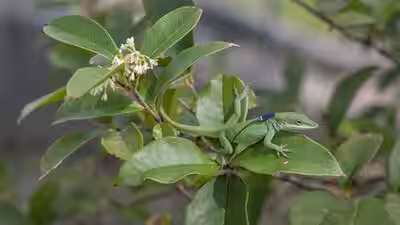

What if the wildlife moving around a university campus could become part of a student’s research project? At the Georgia Institute of Technology in the US, this is about to become a reality. Students will soon use miniature tracking devices to follow the movements of butterflies, birds and lizards, turning everyday encounters with wildlife into opportunities for scientific investigation.The technology behind the initiative is particularly striking. Some of the sensors weigh just 0.03 grams, approximately the weight of two grains of rice. Small enough to be carried by a lizard, these devices use Bluetooth-enabled tracking technology to help researchers understand where animals move, which habitats they prefer and how they interact with their surroundings.Announced by Georgia Tech’s School of Biological Sciences, the initiative aims to involve more than 800 students annually. Its larger objective is to make the university campus a living laboratory for studying urban biodiversity.
Tiny sensors, big questions about wildlife
The project is being led by James Stroud and Benjamin Freeman, both Elizabeth Smithgall Watts Early Career Assistant Professors in Georgia Tech’s School of Biological Sciences.Students will investigate several species, including green anole lizards, northern mockingbirds, northern cardinals, eastern bluebirds and eastern towhees. Migratory butterflies, particularly monarchs and gulf fritillaries, will also be part of the tracking programme.There is already a promising starting point. Researchers from Stroud’s laboratory recently surveyed green anole lizards around the university’s Kendeda Building EcoCommons and identified a population of approximately 50 individuals. Tracking these lizards could help students examine how individual animals use their habitats and respond to environmental changes.In Georgia Tech’s official announcement, Stroud described wildlife tracking as an important frontier in ecological research.“Recording animal behavior in the wild is one of the final frontiers in ecology and evolution research,” Stroud said in the university’s announcement. He explained that the technology would allow students to design research projects while learning data collection, spatial analysis, statistical modelling and scientific communication.
More than 800 students to get hands-on research experience
One of the initiative’s distinguishing features is that it will extend beyond traditional biology and ecology programmes. Georgia Tech plans to involve students from engineering, computer science and public policy as well.The interdisciplinary approach will allow students to explore different aspects of wildlife research. Engineering students will work with sensor technology, computer science students will develop data visualisation tools, while those interested in public policy can examine how urban development and planning decisions affect wildlife habitats.According to Freeman, the initiative is designed to give undergraduates exposure to all stages of scientific research, from deploying tracking devices to analysing the information they collect.The university also has a longer-term goal. Within five years, Georgia Tech hopes to develop a dynamic biodiversity map of its campus, allowing students, researchers and members of the public to observe the movements of hundreds of tagged animals.
How campus research could contribute to wildlife conservation
The project will build on environmental monitoring already taking place around the Kendeda Building EcoCommons. Sensors at the site record environmental conditions such as temperature, humidity, wind and soil quality.Combining these readings with animal movement data could help students investigate how wildlife responds to changing environmental conditions. For instance, researchers could examine whether temperature influences where lizards seek shelter or how birds use different parts of the campus.The researchers also bring experience from projects outside the university. Stroud has spent more than a decade studying lizard populations on Lizard Island, while Freeman is developing a wildlife monitoring project in Ecuador to study tropical bird movements across different forest environments.Georgia Tech’s campus initiative will bring elements of this research experience into undergraduate education.Beyond the classroom, the findings could help researchers understand how urban green spaces support wildlife and how cities can accommodate biodiversity as they expand.For students, the project offers an opportunity to approach scientific questions differently. A butterfly crossing a campus garden or a lizard resting on a tree may soon become more than an everyday sight. With a tiny sensor and the right research question, each could offer valuable clues about how wildlife survives in an increasingly urbanised world.
Discover more from updatview
Subscribe to get the latest posts sent to your email.