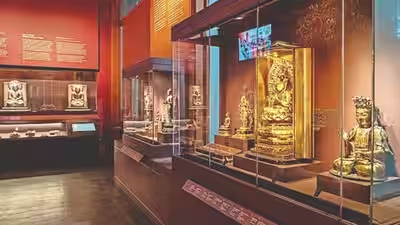


MUMBAI: Centuries ago, in present-day Sindh, Kahu-jo-daro, a Buddhist stupa stood as a testament to the region’s religious and liberal artistic traditions. Its walls, adorned with intricate terracotta figures and decorative architectural elements, reflected a world shaped by the exchange of ideas across cultural boundaries.But when it was excavated over a century ago by Henry Cousens of the Archaeological Survey of India in 1909-10, the remains of the stupa were scattered. Now, a cataloguing of the collection of artefacts housed in Chhatrapati Shivaji Maharaj Vastu Sangrahalaya (CSMVS) is helping piece together this grand stupa from the Gandhara region and restoring it to its rightful place in the story of Buddhist architectural traditions.CSMVS on Tuesday launched ‘Kahu-jo-daro’, a scholarly work that catalogues and attempts to reconstruct the ancient monument near Mirpurkhas in Sindh, Pakistan. Authored by CSMVS director general Sabyasachi Mukherjee, with research and cataloguing by Aparna Bhogal, the museum’s curator of archaeology, the project was backed by Bank of America. Cataloguing is the process of creating a metadata of the object by research and documentation. Cyrus Guzder, chairman of the board of trustees, said, “Catalogues provide an authoritative record of each object paving a foundation for research and scholarship.”Though dating largely to the 4th-5th century CE, the stupa’s exact date of origin is unknown. The surviving remains include terracotta Buddha figures, decorative bricks, and architectural fragments, which offer insights into the Buddhist heritage of the region. CSMVS houses the largest and most comprehensive collection of artefacts recovered from the site. Mukherjee said the catalogue contains 313 architectural fragments of Kahu-jo-daro. “It has been 20 years since I’ve been researching on the stupa.”Drawing on the collection, Bhogal said the cataloguing project started with a planning stage. “I received important contextual information about the stupa and found some parts were missing”. The artefacts were first identified, then visually analysed. Here, Bhogal also had to refer and formulate a comparative study with other artworks. The research has traced artistic influences of the Gandhara and Kushana-Gupta traditions on the stupa.Thanks to the research, the forgotten stupa of Kahu-jo-daro has now found a renewed place in the story of Buddhist art and architecture.
Discover more from updatview
Subscribe to get the latest posts sent to your email.