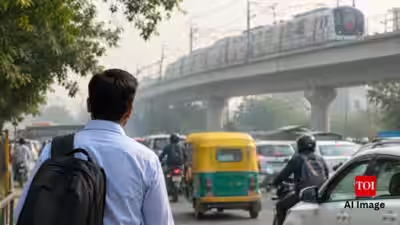







NEW DELHI: Delhi’s air quality improved marginally on Thursday morning, with the national capital recording an overall Air Quality Index (AQI) of 321 in the ‘very poor’ category.However, a thick layer of smog continued to engulf several parts of the city, reducing visibility during the early morning hours.According to Central Pollution Control Board (CPCB) data recorded at 7am, PM10 and PM2.5 remained the major pollutants across the national capital, news agency ANI reported.Among the monitoring stations, NSUT Jaffarpur recorded the highest AQI at 399, followed by Chandni Chowk at 387, Pusa (IITM) at 386, NSIT Dwarka at 383 and JNU at 378. Punjabi Bagh recorded an AQI of 371, while CRRI Mathura Road registered 365.Chhawla recorded an AQI of 368, Aya Nagar 363, Talkatora Garden 362, Commonwealth Sports Complex 352 and Sirifort 347. Ghummanhera registered 331, while Tikri Kalan recorded 320, Shadipur 316, Burari 314, Uttam Nagar 309 and Jharoda Kalan 304.Other monitoring stations, including Karala, Maidan Garhi, Mandir Marg and Pusa (DPCC), recorded AQI levels of 256, 289, 289 and 269, respectively. No readings were available for Lodhi Road and Badarpur, ANI reported.Delhi’s air quality deteriorated after Diwali celebrations on November 8, with residents waking up to a thick blanket of smog on Monday.Several monitoring stations had recorded AQI levels above 400, falling in the ‘severe’ category, while visibility remained poor during the early morning hours.The persistent pollution has been compounded by falling temperatures and moderate fog.Meanwhile, the Delhi government has been undertaking pollution-control measures to minimise the impact of particulate matter, including deploying water sprinklers across the state.Earlier on Wednesday, the Member Secretary and Members (Technical) of the Commission for Air Quality Management (CAQM) met a delegation of the Aam Aadmi Party at the CAQM office and heard its concerns and grievances regarding air pollution in Delhi.The development comes after CAQM invoked Stage III of the Graded Response Action Plan (GRAP) across Delhi-NCR on November 6, three days ahead of Diwali, amid concerns over a further deterioration in pollution levels.With Stage III measures in force, existing restrictions continue alongside additional pollution-control measures, increased enforcement and directions to concerned agencies to prevent further deterioration in air quality.The emergency action plan applies across Delhi and adjoining districts of Haryana, Uttar Pradesh and Rajasthan. It is invoked as a precautionary measure based on meteorological and pollution forecasts provided by the India Meteorological Department (IMD) and the Indian Institute of Tropical Meteorology (IITM).This allows restrictions to be implemented before citywide AQI levels reach the ‘severe’ category, ANI reported.GRAP is a four-stage emergency framework managed by CAQM in coordination with the CPCB and regional state governments. Restrictions become progressively stricter as air quality deteriorates.Meanwhile, Mumbai recorded an AQI of 146 in the ‘moderate’ category, according to CPCB data. The area around Bandra Reclamation recorded an AQI of 199, also in the ‘moderate’ category, at 7.10am.Across Maharashtra, Bhiwandi recorded the highest AQI at 221, followed by Malegaon at 208. Both areas fell in the ‘poor’ category. Pimpri-Chinchwad recorded an AQI of 182, Sangli 180, Parbhani 177, Jalgaon 165, Nanded 163 and Chandrapur 162.Other cities and areas recorded the following AQI levels: Nashik (152), Belapur (150), Mahad (149), Mumbai (146), Thane (146), Dombivli (144), Navi Mumbai (140), Ambernath (139), Dhule (138), Jalna (134), Mira-Bhayandar (125), Ahmednagar (118), Virar (118), Vasai (113), Ulhasnagar (111), Akola (108), Kolhapur (103), Kalyan (101), Amravati (100), Solapur (97), Satara (95), Aurangabad (93), Badlapur (90), Latur (90), Boisar (88), Beed (83) and Hingoli (62).According to CPCB classification, an AQI between 0 and 50 is considered ‘good’, 51-100 ‘satisfactory’, 101-200 ‘moderate’, 201-300 ‘poor’, 301-400 ‘very poor’ and 401-500 ‘severe’.(With agency inputs)
Discover more from updatview
Subscribe to get the latest posts sent to your email.