

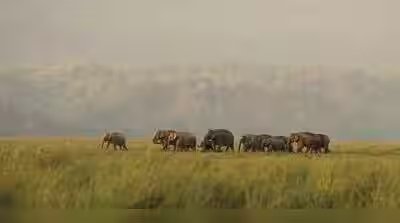

Kolkata: A proposed rail link between Banarhat in north Bengal and Samtse in Bhutan is nearing the planning stage, raising concerns over its impact on two crucial elephant corridors in the Dooars, including one recently cleared by the Union environment and forests ministry (MoEF) for restoration. The detailed project report is ready, and railway officials have begun consulting district authorities on land and other ground-level requirements.The approximately 20-km Banarhat-Samtse line, estimated to cost Rs 577 crore, is part of India’s first cross-border rail connectivity initiative with Bhutan. Sources said over 3,000 trees are likely to be felled, but railway officials did not confirm this.The two corridors at risk are the Rethi-Titi corridor via Dumchi and the Rethi-Titi direct corridor. The latter connects Titi Reserve Forest, the northern part of Jaldapara National Park, with Rethi Reserve Forest in Jalpaiguri division, and further links to Gorumara National Park.“The corridor via Dumchi, approximately 14-16 km in length, is used by elephants to move between Jaldapara and Gorumara, with brief halts in Dumchi, from where Jaldapara’s famous Holong river originates,” said Avijan Saha, project coordinator of Airavat, a wildlife conservation NGO.Elephants use the Titi river, Mujnai and Hantupara tea gardens, Dumchi Reserve Forest and areas around Gopalpur and Singhania tea gardens before entering Rethi Reserve Forest.“The corridor has already been squeezed by expanding settlements, tea garden infrastructure, drainage trenches and other human interventions,” said Kaustav Chowdhury of SNAP Foundation. The rail link could add another layer of fragmentation.Shiv Sambhu Biswas of Voice of Birpara said the entire forest stretch from Sevoke is an elephant route. A railway line once connected Banarhat to Chamurchi, near the Bhutan border, and he suspects the project seeks to revive it.An elevated corridor, like the one planned for the NH 327 widening in north Bengal, could let wildlife pass beneath, he said, but the alignment remains a concern. “The area falls under Moraghat range, which records the maximum elephant deaths due to train hits,” he said.A source said a direct alignment to Chamurchi may avoid forest land, but a diversion via Rethi could bring forest land into the route. Whatever the alignment, the line could disrupt elephant movement between Buxa and Naxalbari.Railway officials said a meeting with district authorities on Saturday discussed land requirements and the presence of tea gardens. Alipurduar divisional railway manager Devendra Singh said all requisite permissions had been obtained so far. “The DPR is ready. Survey has begun. The only issue now is land acquisition,” he said.Forest minister Manoj Oraon said he would comment only after receiving details of the project. A senior forester said the forest department’s clearance would be needed if forest land was involved.Conservationists are also worried about the larger implications of better connectivity with Bhutan. The entire stretch between the Teesta and Sankosh is part of a dolomite-rich belt, with rivers such as Jaldhaka, Diana, Kaljani, Torsa, Jayanti and Sankosh carrying mineral-rich sediment from the Bhutan hills.With the Rajabhatkhawa-Jayanti rail line also reportedly being revived, there are fears that future connectivity could increase pressure for dolomite extraction, potentially harming fragile forest and river ecosystems, including the Buxa landscape.(Inputs from Subhajoy Roy)
Discover more from updatview
Subscribe to get the latest posts sent to your email.