

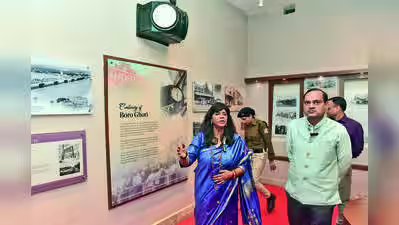

Kolkata: In 1854, the first train of Eastern India chugged out of Howrah station and over a century later, a proper building was set up for Sealdah Station. Artefacts and archives, standing a testament to such episodes that are an integral part of the evolution of railways in Eastern India, will be on display at a gallery that was inaugurated on the premises of Prinsep Ghat station on Sunday, as part of World Heritage Week celebrations. It will remain open to the visitors between 4 pm and 8 pm on weekdays, said Gitika Pandey, the general manager of Eastern Railways.The two major stations of Eastern Railways — Howrah and Sealdah— had humble beginnings. Howrah Station started functioning with one platform in 1854.Today, it has 24 platforms. Sealdah Station began operations in 1862 with four platforms under a tin-roof structure. A proper station building was constructed in 1869.A brief history of today’s Circular Railway has also been put up. The Circular Railway is an amalgamation of railway networks developed by Eastern Bengal Railway, Port Commissioner and Calcutta Municipal Garbage Railway. It was initially set up exclusively for transporting goods to the warehouses along the Hooghly, said an official. In Jan 1953, govt set up a committee to explore the possibilities of converting it into a passenger service line.Many would not know that the city’s municipal corporation once ran a railway service. Corporation of Calcutta, now Kolkata Municipal Corporation (KMC), operated the service for ferrying the waste of the city to Dhapa, then known as Square Mile.Railway officials said the tracks for this railway started from Bagbazar and ran through the Circular Road, Theatre Road, Dharmatala Street, Entally Crossing and Tangra to reach Square Mile. Besides carrying the city’s waste, the line was also used to transport road-building materials to various depots of the Corporation. Among the exhibits, pictures of a steam loco shed of erstwhile Eastern Bengal Railway and a 1978 picture of Ranaghat station embellish the gallery.A tour of the gallery reveals that a scheme to build railway lines from the city to Chittagong in Bangladesh, through the Sunderbans, had been proposed once.But it was subsequently dropped. The gallery also has a mention of Tagore’s final train journey from Bolpur to Howrah on July 25, 1941.
Discover more from updatview
Subscribe to get the latest posts sent to your email.