




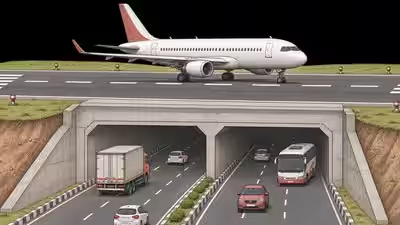

VARANASI: For nearly two decades, the expansion of Lal Bahadur Shastri International Airport in Varanasi remained caught in an unusual geographical predicament.A railway line ran along its eastern side, while the Varanasi-Lucknow national highway lay to its west. Extending the runway was essential to accommodate larger aircraft, but doing so meant confronting a question that had no conventional answer: How could the airport expand without disrupting a major highway?The solution was to take the highway underground.Varanasi is now building a 2.89-km underpass on NH-31, allowing the airport’s expanded runway to pass above it.

The underpass is designed to ensure that highway traffic can continue moving beneath the expanded runway rather than being diverted or interrupted by airport operations.
Once completed, the project will make it the first airport in India to have a national highway running beneath its runway. The underpass, being constructed by the National Highways Authority of India (NHAI), is estimated to cost Rs 649.44 crore, while the larger airport expansion project is worth around Rs 2,870 crore.

Nearly 60% of the underpass work had been completed by November 2026, while the new terminal building had reached 71% completion.
Nearly 60% of the underpass work had been completed by November 2026, while the new terminal building had reached 71% completion. The underpass is targeted for completion by March 2027, while the terminal is expected to be ready by July 2027.The project is not merely about building a tunnel beneath an airport. It is an attempt to resolve a long-standing infrastructure conflict involving two transport networks that had left little room for the airport to grow.
A plan that remained on paper for two decades
The Airports Authority of India (AAI) had proposed extending the airport’s runway in its 2004 masterplan. The existing runway, measuring around 2,750 metres, was considered inadequate for the airport’s long-term ambitions, particularly its ability to handle larger passenger aircraft and cargo planes.

The Airports Authority of India (AAI) had proposed extending the airport’s runway in its 2004 masterplan
The proposal envisaged extending the runway to 4,075 metres. But the geographical constraints proved difficult to overcome.With a railway track on the eastern side, the airport’s expansion could only take place towards the west, where the Varanasi-Lucknow highway was located. Extending the runway in that direction meant that the highway’s existing alignment would have to be preserved even as the airport expanded above it.The AAI approached the Uttar Pradesh government in March 2015, seeking the land required for the expansion. The proposal gained momentum in 2017 when the authority restarted the process of identifying land.In 2018, the AAI approved a plan to extend the runway over the highway while providing an underpass for vehicular movement. The proposal also offered a solution to the long-pending alignment issue on the highway, which was being upgraded.“It will be India’s first highway to pass under the runway of an airport. The proposed underpass will also solve the long-pending issue of deciding the alignment of NH-56, which is being converted into a four-lane road,” NHAI project director (Varanasi) S B Singh told TOI in 2018.

The airport’s annual passenger-handling capacity is expected to rise from 39 lakh to around 99 lakh.
Despite the approval, the project did not move at the pace envisaged. Land acquisition requirements and other administrative and technical issues continued to hold it up.
Fog exposed the cost of a short runway
The urgency of expanding the airport became more apparent in January 2023, when poor visibility disrupted flight operations.On the night of January 8, Uttar Pradesh chief minister Yogi Adityanath’s departure from Varanasi was cancelled after dense fog prevented his flight from taking off. He had to return to the circuit house for the night. The following day, he was also made to wait at the airport for visibility to improve.

The Airports Authority of India has taken assistance from experts at IIT Delhi for the tunnel’s design
During his visit, the CM sought an explanation for the difficulties faced by the airport during extreme weather conditions.Officials informed him that the airport had an Instrument Landing System (ILS) of Category I, whereas Category III systems permit aircraft to land in much lower visibility conditions. A longer runway was also part of the airport’s infrastructure requirements.Adityanath subsequently directed officials to expedite the runway expansion process.In July 2023, the district administration sought Rs 1,030 crore from the state government’s civil aviation department for acquiring land across seven villages. The AAI’s original requirement had included 593.77 acres in Mangari, Bikunthpur, Karmi, Ghamhapur Karmi, Sagunaha and Pura Raghunathpur.The Union Cabinet cleared the larger airport expansion proposal in June 2024, and the foundation stone for the airport development project was laid by Prime Minister Narendra Modi on October 20, 2024.The separate underpass project subsequently received its own push. Modi laid the foundation for the 2.89-km tunnel in April 2025.
How the project will change the airport
The underpass is only one part of a comprehensive expansion plan aimed at more than doubling the airport’s passenger-handling capacity.The runway will be extended from around 2,745 metres to 4,075 metres, allowing the airport to handle larger aircraft. The airport’s annual passenger-handling capacity is expected to rise from 39 lakh to around 99 lakh.The expansion also includes a new terminal building, an extended apron, a parallel taxiway and other associated infrastructure.The new terminal will have an area of around 99,500 square metres, compared with the existing 24,500 square metres. The number of aircraft parking bays will increase from 11 to 20, while peak-hour passenger-handling capacity will rise from 1,050 to around 6,050.The new terminal is also being designed to reflect Varanasi’s cultural identity. Its architectural elements draw inspiration from the trident of Lord Shiva, the Kashi Vishwanath Dham and the jharokhas of Rajasthan’s palaces. Its interiors will feature representations of Nataraja’s mudras, the ghats along the Ganga, boats and local handicrafts.The airport’s expanded area will cover 774 acres, including 639 acres inside and 135 acres outside the airport premises.
Keeping road traffic moving while the airport grows
The underpass is designed to ensure that highway traffic can continue moving beneath the expanded runway rather than being diverted or interrupted by airport operations.The Airports Authority of India has taken assistance from experts at IIT Delhi for the tunnel’s design. Safety arrangements outlined for the project include round-the-clock video surveillance, route-patrolling vehicles and ambulances for emergency assistance. CRPF personnel are also to be deployed on both sides of the tunnel.The construction requires coordination between the AAI, NHAI, the district administration and the executing agencies, given that the runway and highway infrastructure are being developed as part of the same expansion plan.During an inspection on November 21, divisional commissioner K Vijayendra Pandian reviewed the progress of the terminal and underpass projects. He directed officials to accelerate construction while maintaining quality standards and ensuring that the work was completed within the stipulated deadlines.With nearly 60% of the underpass construction complete, the March 2027 deadline is now the next major milestone.For Varanasi, the project represents the resolution of a planning dilemma that had persisted since the airport’s expansion was first proposed. Rather than forcing the airport and highway to compete for the same stretch of land, the solution has been to place one transport corridor beneath the other.The result will be an airport runway extended over a national highway, allowing aircraft and road traffic to use the same geographical space without sharing the same level.(With inputs from Rajeev Dikshit)
Discover more from updatview
Subscribe to get the latest posts sent to your email.