

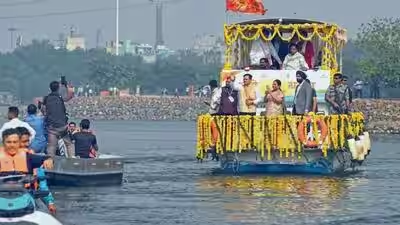

NEW DELHI: A cruise ride on the Yamuna, a minister riding a jetty along its banks, a BJP MP swimming in it and AAP MLAs floating his effigy at another stretch. In the run-up to Chhath this year, Yamuna cleaning has taken centrestage in Delhi.This week, CM Rekha Gupta took the inaugural ride on a cruise launched on the Sonia Vihar-Jagatpur stretch while minister Parvesh Verma rode a jetty. A week earlier, BJP MP from North East Delhi Manoj Tiwari swam in the Yamuna to demonstrate its water was clean. Days later, AAP MLAs floated an effigy of Tiwari at Kalindi Kunj, challenging him to take a dip there instead – a stretch they claimed was far more polluted.The political contest over the river is not new. In Oct 2025, a controversy erupted over a temporary artificial pool or water channel constructed at Vasudev Ghat, with AAP alleging it was meant to create an impression of a clean Yamuna ahead of PM Modi’s scheduled visit for Chhath, which eventually did not happen.These episodes, unfolding in just over a year since BJP assumed office in Delhi, underline how the river and the festival have become intertwined with the capital’s political messaging.But the script was not very different when AAP was in power. From Jat leader Parvesh Verma defying DDMA restrictions to gather at the Yamuna for Chhath during Covid, to then CM Atishi, who’s from the Punjabi community, performing Chhath and leaders from the Bania community such as Arvind Kejriwal and Vijay Goel making appearances at ghats, the festival has long offered politicians an opportunity to connect with voters.Chhath’s growing political significance has much to do with Delhi’s changing demography. The Poorvanchali community, a broad term commonly used for people from Bihar, eastern UP and non-tribal parts of Jharkhand, is estimated to account for over 30% of Delhi’s population and electorate.Sidharth Mishra, author of Delhi Political 1947-2013, said the festival’s character in Delhi has acquired a distinctly political dimension. “If you see the way Chhath is celebrated in Bihar and Jharkhand, it is very different from Delhi. The essence of the festival has been simplicity and cleaning of the river or ghat. But in Delhi, it has also become a reach-out occasion for politicians. For instance, you will hardly see politicians’ banners at ghats in Poorvanchal, but in Delhi you will see large hoardings of them,” he said.Over the years, the festival’s institutional recognition has grown. Delhi govt declared Chhath Puja a public holiday for the first time in 2014. This year, with the evening arghya falling on Sunday, govt has declared Monday a holiday for the morning arghya. Sources said this was done to appease the Poorvanchal community. Delhi govt is also setting up 1,482 Chhath ghats across 996 locations, the scale of the arrangements reflecting how the festival has become part of the city’s civic calendar.Pavan Chaurasia, assistant professor at DU’s Shivaji College, said the capital’s political transformation over the past couple of decades is closely linked to demographic and economic changes.“People from the eastern part of India, especially Bihar and eastern UP, have settled in Delhi in huge numbers, thereby making them a significant vote bank. Secondly, the community itself has witnessed a massive economic transition in past two decades. From being categorised as lower middle class or working class, they have now joined elite groups like diplomats, bureaucrats, professors, doctors and lawyers, making them both a social and economic force,” he said, adding that the community’s growing influence is often reflected in its cultural celebrations.Beyond the political symbolism, Chhath has emerged as an annual public audit of Yamuna’s condition. The river may be viewed from bridges and embankments through much of the year, but the festival brings thousands of devotees directly into contact with its water. Froth on the Yamuna is a recurring sight, but its political impact becomes far greater when photographs show devotees performing rituals amid the foam.Former MP Mahabal Mishra of Congress was the first to speak of Poorvanchalis in Delhi and had demanded a Chhath holiday. Later, when AAP entered the fray in 2013, it gave tickets to a large number of people from the community. In 2016, BJP made Manoj Tiwari its state president. The current BJP govt has given Pankaj Singh, who comes from Buxar, a place in its cabinet.In the 2025 general elections, BJP had changed all candidates in Delhi except Tiwari, with sources attributing the move to his Poorvanchali background.
Discover more from updatview
Subscribe to get the latest posts sent to your email.