

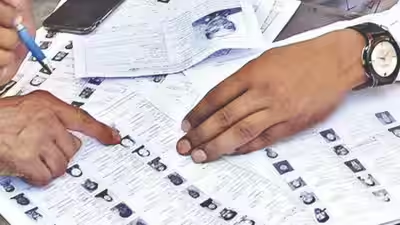

MUMBAI: Nearly one in three electors in Mumbai and its satellite constituencies has been struck off the draft electoral rolls during the Special Intensive Revision (SIR), with the exercise removing 2.07 crore names across Maharashtra, according to a preliminary independent study by the SABAR Institute.The scale of the exercise is particularly significant in the Mumbai Metropolitan Region (MMR), where high population mobility, migration and frequent changes of residence could complicate electoral verification.The study found that Mumbai’s 36 assembly constituencies account for 17% of Maharashtra’s total deletions despite having only 11% of its pre-revision electorate. The deletion rate in these constituencies was 34.7%, against 19.5% in the rest of the state.Even more strikingly, 83% of the 2.07 crore names removed across Maharashtra were not classified as deaths. Instead, they were categorised as permanently shifted, untraceable or absent, or already enrolled elsewhere. Only 16.8% of deletions were attributed to deaths, the report said.The findings raise important questions about how eligible voters who migrate for employment, relocate after marriage or move between rented accommodation can ensure that their names remain on electoral rolls.
Thane, Mumbai City among worst-affected districts
Thane recorded 28.59 lakh deletions, representing 38.4% of its pre-SIR electorate of 74.50 lakh.Mumbai City followed with 9.50 lakh deletions, or 37.2% of its 25.55 lakh electorate, while Mumbai Suburban recorded 26.58 lakh deletions, amounting to 33.9% of its 78.30 lakh electorate.In terms of deletions for reasons other than death, Thane topped the state at 35.4%, followed by Mumbai City at 31.6% and Mumbai Suburban at 29.7%.Pune, Nagpur and Palghar also recorded substantial non-death deletion rates of 28.1%, 25.9% and 25.1%, respectively.The report suggests that urbanisation is a stronger indicator of deletion patterns than the caste or religious composition of districts.
Colaba, Malad West and Mumbadevi figures raise questions
At the constituency level, Colaba recorded 1,19,606 deletions, equivalent to 46.9% of its pre-revision electorate. This was the second-highest deletion proportion among Maharashtra’s 288 constituencies.More significantly, the number of deleted names was 1.01 times the 1,18,499 votes cast in the constituency during the 2024 assembly election. Colaba was the only constituency in the state where deletions exceeded votes cast in that election.Malad West recorded 1,41,584 deletions, or 38.6% of its electorate of 3.67 lakh. The constituency’s 2024 assembly election was closely contested, with Congress’s Aslam Shaikh defeating the BJP’s Vinod Shelar by 6,227 votes.Mumbadevi recorded 93,533 deletions, or 38.5% of its pre-revision electorate. The researchers, however, flagged a discrepancy of 66 names between their extraction of the constituency’s ECI reports and the official count published by the chief electoral officer.
Deletions exceed election victory margins in 190 seats
The electoral implications are another major concern highlighted by the study.The number of non-death deletions exceeded the 2024 assembly election victory margin in 190 of Maharashtra’s 288 constituencies. In 95 constituencies, the untraceable/absent category alone exceeded the winning margin.The researchers also examined whether constituencies won by the BJP-led Mahayuti and the opposition Maha Vikas Aghadi (MVA) were affected differently.Although the unadjusted figures showed variations, the difference disappeared after accounting for Mumbai, region, reservation status, urbanisation and electorate size.Instead, the strongest statistical association was with voter turnout.Constituencies with lower turnout in the 2024 assembly election tended to record higher non-death deletions, suggesting a relationship between lower electoral participation and older or less frequently updated voter rolls.Women, young voters and third-gender electorsThe report found that women and men were removed at almost identical overall rates, 21.4% and 21.2%, respectively. However, among voters aged 18-29 marked as permanently shifted outside Mumbai, 8.22 lakh were women compared with 3.80 lakh men, a ratio of 2.2:1.Researchers said this pattern was consistent with women moving to their husbands’ homes after marriage and having to enrol at their new addresses.In Mumbai, the pattern was reversed, with 85,167 young men and 76,848 young women recorded among the deletions, which the study said was consistent with male-dominated labour migration.Third-gender electors were disproportionately affected. As many as 3,250 of the 6,101 third-gender electors on the 2024 roll were included in the deletion list, translating into a deletion rate of 53.3% — about two-and-a-half times the statewide average.The study also found that Muslim-named electors constituted 14.6% of all deletions, compared with an estimated 12.1% share based on Census 2011.After controlling for age and constituency, their odds of being classified as already enrolled elsewhere, rather than dead, were 2.07 times those of other electors.The researchers stressed that religion was estimated through a name-based statistical classifier and was not an attribute recorded by the Election Commission of India (ECI).The report also cautioned that these findings do not establish deliberate targeting or discrimination.
Study calls for transparency and accessible appeals
The preliminary report analyses ECI’s constituency-wise absent, shifted, dead and duplicate (ASD) lists for the SIR-2026 draft roll, CEO Maharashtra’s pre-revision electorate data, 2024 assembly election results and Census 2011 data.Its constituency-level deletion totals match the CEO Maharashtra figures in 287 of 288 seats. The exception is Mumbadevi, where 66 entries were missing from the ECI’s published reports.The researchers also noted that 51 of the state’s 1,00,216 polling parts had no published report.Importantly, the study analyses names left off the draft roll; it does not establish how many of these electors will ultimately remain excluded from the final roll. Some may have reapplied and could be restored.The institute has called for greater transparency in verification, accessible appeals, legal assistance for affected electors and independent scrutiny of automated tools and discrepancy filters.It has also sought a comprehensive national study examining deletions, restorations, appeals and the wider social and economic consequences of electoral exclusion.
Discover more from updatview
Subscribe to get the latest posts sent to your email.