




MUMBAI: For a city that measures its mornings in train timings and its evenings by the rush to catch the last local, the suburban railway is more than a way to get from one place to another. It is the thread that holds together Mumbai’s daily routine. But lately, that journey has come with reminders of how easily the thread can fray.For a 20-year-old woman travelling home from Borivli to Naigaon, the journey turned into a nightmare. She was allegedly molested by a fellow passenger inside a crowded local.When she confronted him at Naigaon station, the altercation continued on the platform. The man allegedly pushed her onto the tracks; as she tried to climb back up, the train began moving. She lost her left arm below the elbow.The incident is difficult to comprehend as anything other than a horrifying breach of the safety a public transport system is expected to offer. But it is not the only recent instance of a routine journey turning violent.A 22-year-old man, Mayank Lohar, was stabbed to death inside a moving Churchgate-Nallasopara local after an argument over closing the coach door during heavy rain.In another case, a woman ticket checker was allegedly bitten and scratched by a passenger after imposing a penalty for travelling without a ticket.These incidents are different in their circumstances, but share one unsettling feature: they unfolded during journeys that are part of the city’s everyday routine.For the millions who depend on the suburban network, the risks of travelling are not always limited to reaching the destination. And safety is only one part of the uncertainty that commuters have to contend with.
The daily commute, with an extra helping of uncertainty
The trouble does not always begin with a serious offence. Sometimes, an argument over a few inches of standing space is enough to turn a moving train into a dangerous place.A few days ago, a video surfaced on social media, which showed two passengers fighting near the doorway of a Churchgate-Virar fast local, with one appearing to fall onto a platform. Railway police said no complaint had been registered and the station could not be identified.A confrontation need not even begin inside a train to put passengers in danger.At Vikhroli, an argument between two men inside a station washroom spilt onto the tracks when one of them entered the path of an approaching local, threatening to stop it. A fellow passenger pulled him away moments before the train arrived. Neither man filed a complaint.At Kandivali, meanwhile, a ticket-checking exercise escalated into a confrontation after a woman travelling without a valid ticket was stopped by a chief ticket inspector. Her clothes were allegedly partially torn during the incident, and a crowd later gathered outside the ticket-checking office, demanding an apology from the inspector. Western Railway and the people gathered there gave differing accounts of the episode.Not every risk comes from a fellow passenger, either. At Churchgate, a passenger sustained head injuries after two drones lost control during a private company’s show and crashed inside the station.The incidents may differ in seriousness and circumstance, but together they offer a glimpse of how many things can go wrong in a space that is part of millions of people’s everyday routine.And when a network carries such a large volume of passengers, even a problem that begins in one coach or at one station can quickly become difficult to contain.The uncertainty extends beyond passenger behaviour. The railway’s ability to keep services moving depends on several systems working together, leaving little room for error when equipment fails or the tracks are obstructed.And when the problem is not confined to one coach or one platform, the consequences can travel across the city.

Mumbai monsoon mayhem
One small fault, a very long Monday
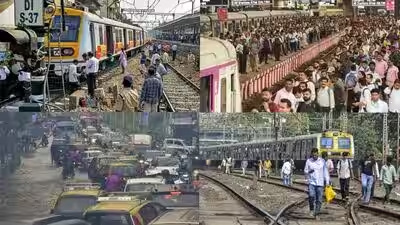
On a Monday morning, a fire in a signalling hut at Kanjurmarg exposed just how dependent the network is on every part of its operation working as it should. Around 24 signals went blank across all six lines between Vikhroli and Bhandup.An overhead-equipment snag between Mulund and Thane had already led to a power block earlier that morning. What followed was not a delay confined to one station or one stretch of track. With two separate problems affecting operations, the disruption was not confined to one station or one stretch of track.Central Railway cancelled 80 local services, while delays stretched to 70-90 minutes. Trains stood still for long periods, platforms filled up and some commuters got down and walked along the tracks.The disruption spilt over to the Harbour line, where a shortage of train crews added to the impact. Long-distance services were delayed, too. Students struggled to reach colleges for internal examinations, forcing some institutions to reschedule them.The signals were restored by 7.35pm, but services continued to run late into the night. What began with a fire at one signalling hut had affected services across a much wider stretch of the city.That is the peculiar arithmetic of Mumbai’s suburban railway. A problem at one point can affect trains behind it, services on adjoining lines and passengers nowhere near the original fault.The reason is partly operational: when signalling is unavailable, trains cannot simply continue at their usual frequency. Railway personnel have to follow alternative operating procedures and prescribed safety clearances, slowing movements and allowing delays to accumulate.The Kanjurmarg incident was not an isolated example. In November, a fire suspected to have been triggered by firecrackers damaged signalling cables between Virar and Nallasopara. 14 12-core cables and six six-quad cables were damaged, affecting seven signals.14 suburban services were delayed on November 8; the following Monday, 35 services were cancelled and 150 delayed as restoration work continued.Not every disruption, however, begins with a fire or a major equipment failure. Sometimes, a relatively small obstruction is enough to bring services to a halt.On another morning, a piece of cloth got entangled in the overhead wire at Sewri, forcing railway authorities to switch off the power supply while it was removed. Harbour line services were disrupted for nearly half an hour during peak hours, with two trains held up and some passengers getting down to walk along the tracks.A separate technical fault between Tilak Nagar and Chembur caused the pantograph of a Panvel-bound local to come down from the overhead wire, affecting three trains over a seven-minute disruption.Equipment failure is only one source of interruption. Passenger actions can also hold up services, with the impact extending well beyond the train involved. Central Railway recorded seven chain-pulling incidents in a single day, involving both suburban and long-distance trains.In one instance, a local was held up after its emergency chain was pulled between Vidyavihar and Kurla. Railway officials pointed out that unauthorised chain-pulling affects not just the train concerned but also services operating behind it, setting off a chain reaction of delays.

Reported incidents
The duration of a glitch, then, does not always tell the full story. A few minutes can be enough to hold up several services; a longer failure can upset travel plans across a much wider stretch.For commuters with fixed reporting times, examinations, hospital appointments or connecting journeys, a delay is not simply a number on a railway update. It is time they cannot get back.And while unexpected faults can bring services to a standstill, the railway also has to take planned breaks to keep its infrastructure functioning.
When the tracks need a break, the city doesn’t
For a railway network that is expected to keep moving through much of the day, maintenance comes with an awkward contradiction: the tracks need time off, but the city rarely gets one.Central Railway’s periodic megablocks are meant to make room for essential engineering and maintenance work. For commuters, however, they mean another round of altered routes, cancellations and adjusted timings.During one such block, services on the Main line between Thane and Kalyan were affected, with slow trains diverted to the fast corridor. Harbour line services between Panvel and Vashi were suspended for several hours, while several services on the Harbour and Trans-Harbour lines were cancelled.To reduce the inconvenience, Central Railway said it would operate special services between CSMT and Vashi, while some other routes would continue to run.The disruption is scheduled, unlike a sudden signalling failure or an obstruction on the tracks.But it brings out the balancing act facing the railway, i.e., maintenance cannot be put off indefinitely, yet carrying out the work means temporarily taking parts of the network out of service.For passengers, the distinction between a planned block and an unexpected glitch may matter less when either one changes the time it takes to get home. The challenge, therefore, is not simply to restore services after a disruption, but to maintain and upgrade a network that the city continues to rely on every day.Western Railway, for instance, has been clearing land for the approach road and connecting tracks to the upcoming Jogeshwari Terminus. The first phase of the Rs 76.48-crore project is expected to open by early 2027, with four widened platforms designed to accommodate 24-coach long-distance trains.It is a development in the city’s railway infrastructure, though not a direct solution to the pressures on suburban local services.For the commuters, meanwhile, the question is more immediate: when the local is delayed, cancelled or too crowded to board, what other option is realistically available?
For commuters, there is no easy Plan B
For Shraddha Bhosale, a working Mumbaikar, local trains account for around 80% of her daily travel. They remain the most convenient and time-efficient way to cover longer distances, but that convenience comes with a familiar weekday struggle.During peak hours, overcrowding can make even boarding a challenge, let alone finding a seat. And when services are delayed or cancelled, the impact does not stop at the station. Work schedules and personal commitments have to be rearranged, sometimes at short notice.“I usually try to explore alternative routes or switch to road transport, depending on the urgency and distance. However, during peak hours, even these alternatives can be time-consuming,” she said.The difficulty is that switching to road transport does not necessarily mean escaping the disruption. During the monsoon, it can simply mean encountering a different set of problems.Waterlogging, slow-moving traffic and railway disruptions make journeys unpredictable, she said, identifying areas around Ghatkopar, Dadar, the Harbour line, Thane and the Vasai-Virar stretch as particularly difficult.Road travel offers little relief in several of these areas either, with heavy rain affecting traffic in places such as Andheri and waterlogging and potholes making Thane’s roads difficult to navigate.The alternatives are familiar: BEST buses, taxis, auto-rickshaws and app-based cabs. But they can mean higher costs and longer travel times, particularly when roads are congested or waterlogged.That leaves commuters weighing one difficult journey against another, rather than choosing between a reliable option and an unreliable one.

If not local trains, what else?
For Shraddha, overcrowding is not the only concern. Recent incidents of violence, including the fatal knife attack on a young commuter, have also raised questions about passenger safety.“As commuters, we expect basic security and a safe environment while travelling, but such incidents make people question how secure they really are during their daily journeys,” she said.
A lifeline with very little room for error
The local train’s biggest strength is also what makes every disruption so consequential; so many journeys depend on it.A technical fault can hold up trains well beyond the affected stretch; a chain-pulling incident can delay services following the train; a maintenance block can force commuters to change their usual routes.And when road travel is also affected by congestion or rain, the alternatives may offer little relief.Even a short interruption during peak hours can leave passengers looking for alternatives at stations already dealing with a rush.In other words, a desperate attempt to make one journey easier can end up making several others longer.The same dependence also brings the question of safety into sharper focus. A crowded coach, an altercation between passengers or an incident on a platform can turn an otherwise routine journey into a dangerous one.The local train journey is shaped by more than the timetable: weather, crowding, passenger behaviour, equipment and the railway’s ability to respond all have a part to play.For a city whose routines are so closely tied to its suburban trains, there is little room for any one of these factors to go wrong. The network is expected to carry people to work, colleges and home, often within tight windows of time.Yet the same dependence means that when services falter, commuters have to absorb the consequences by waiting, changing routes, finding another mode of transport or simply arriving late.Mumbai’s locals are called its lifeline for good reason. But a lifeline is only as dependable as the system that keeps it running. And for a city that cannot easily pause when its trains do, keeping that system moving is not just a question of punctuality. It is a question of how much disruption the city can afford.
Discover more from updatview
Subscribe to get the latest posts sent to your email.