




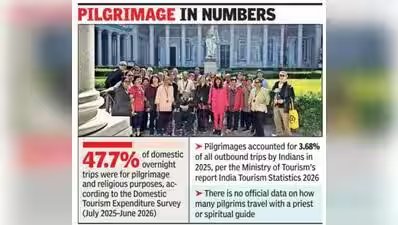

In the world of leisure tourism, two things help a travel ad make a strong sales pitch: place and price. In religious tourism, there’s a third: priests.Earlier this year, a brochure for a tour called ‘Italy with Lourdes & Fatima’ (13 days, 5 countries, 10 cities) featured the usual—landmarks and Christian shrines in Vatican City, Assisi and Lisbon—and the unusual: the beaming face of Fr. Savio de Sales.As the tour’s spiritual leader, Fr. de Sales, secretary of the Commission for Liturgy of the Archdiocese of Bombay and parish priest of the Church of Our Lady of the Rosary, Dockyard, led his roving flock of 40 in prayer, delivered short sermons on the bus, delved into the theological depths of each site and celebrated Mass. In sum, he elevated their experience in a way that even the most pious tour guide couldn’t.Pilgrimage is India’s leading reason for domestic overnight travel and a small share of outbound travel (see box). The number of pilgrims travelling with a spiritual guide is unknown, but among Mumbai’s Catholics, Parsis, Jains and Muslims, it is a draw.Across these faiths, pastors and priests, ervads and muftis, are being sought to shepherd the faithful to places of pilgrimage like Lourdes, France; Yazd, Iran; and Mecca, Saudi Arabia. Apart from their theological expertise, their ability to conduct prayers and rituals at these sacred sites makes a priest-led pilgrimage a big draw for devotees.“As a spiritual guide, one’s job is to prepare the group emotionally and spiritually for the journey,” says Fr. de Sales, who conducted an online prayer service for his group before departure and a thanksgiving service on their return.A tour guide was also assigned to them, but she handled the earthly aspects of the trip, such as site history and bus schedules, leaving the spiritual heavy-lifting to the clergyman. Purple Orchid Holidays, the Christian travel company that organised the tour, bore the priest’s travel costs, while the group chipped in with spending money.“Visiting holy sites makes the Bible come alive,” says Fr. De Sales who, 20 years ago, led his first tour to the Holy Land, the epicentre of Christian pilgrimage. (These tours, covering Israel, Egypt and Jordan, have currently declined because of the West Asia War.) “Pilgrims walk in the footsteps of Jesus at his birthplace in Bethlehem, his hometown of Nazareth and Calvary, the site of his crucifixion,” he continues. At Assisi and Turin, they relive the lives and missionary journeys of saints.The priest turns what would have been a passing visit into an intimate experience. At Kafr Kanna in northern Israel, traditionally identified as the Biblical Cana, where Jesus turned water into wine at a wedding, he has officiated as couples renew their marriage vows. (A priest’s authority to conduct rituals, such as Mass, is why they and not nuns usually lead Christian tours, says Darryl Nunes, founder and managing director of Purple Orchid.)For Parsis, who migrated to India between the 7th and 10th centuries, pilgrimages to Iran (also stalled because of the war) rekindle a more visceral fire. “Many Parsis believe that Iran is our spiritual motherland,” says Ervad Ramiyar Karanjia, a scholar-priest and principal of the Zoroastrian seminary Dadar Athornan Institute.Ervad Karanjia’s two-week pilgrimages typically covered four or five sites of religious and historical importance, such as the Fire Temple of Yazd; the ruins of King Darius’s palaces near Shiraz; and the historic cities of Hamadan and Kermanshah. “It’s a moving experience for people who believe they are walking in the place where the Prophet (Zarathustra) and kings walked,” he says. They even take in the Caspian Sea, the Alborz Mountains and Mount Damavand, all part of Zoroastrian cosmology.Ervad Karanjia explains the historical, religious and architectural significance of each site, conducts rituals, leads the group in hymns and answers questions. “When we visit the ruins of a palace, for instance, we pray to the soul of its king, recalling his goodness and commitment to Zoroastrianism. Praying together strengthens our own commitment to the religion,” he says. “It’s an intensive spiritual experience.”The guidance is also practical, says Nazir Kazi, a pilgrim who travelled this year to Mecca on Hajj with Muhammed Ashfaq Kazi, chief mufti of Jama Masjid, Kalbadevi. “It was my first time on Hajj, and having a spiritual guide helped a lot—to practise the rituals correctly and say the right prayers at the right place and time when circling the Ka’ba,” says Kazi. “Many pilgrims travelling independently seemed lost on what was to be done.”Mufti Ashfaq leads these pilgrimages for Alvi Tours, which, he says, bears his travel costs rather than passing them on to pilgrims. “Very few private tour operators assign a cleric to a Hajj or Umrah group,” says the mufti and founder of Family First Guidance Centre, an Islamic family counselling centre, who leads a group of around 200 hajjis annually, along with another mufti.Spiritual leaders also guide pilgrimages within India. Jain scholar and Saint Pujya Gurudevshri Rakeshji, founder of Shrimad Rajchandra Mission Dharampur, undertakes pilgrimages with His disciples to places such as Shri Sammed Shikharji in Jharkhand and Shri Girnarji and Shri Atmasiddhi Shastra Rachanabhoomi in Gujarat.“A true pilgrimage is a journey from the external to the internal world. These pilgrimages help us on our inner journey,” He said during a recent tirthyatra to Sammed Shikharji.“Pujya Gurudevshri Rakeshji brings context and insight to the journey,” says Bhavin Rupani, trustee and steering committee member at the mission. “His wisdom, the spiritual energy of the site, discourses, chants and bhakti delivered during the journey make it a deeper spiritual engagement.”According to Darryl, religious tours make up 70% of Purple Orchid’s business, drawing 3,000–4,000 tourists annually from India and 1,000–1,500 from abroad. Half these tours are led by priests. “Nearly 100 priests have travelled with us since 2008, the year of our first priest-led tour to the Holy Land,” says Jarryd Nunes, Darryl’s son and director of the company.“The market has grown 20–30% year on year,” Darryl adds.A market that some priests, especially those with good oratorical and people skills, may well have helped grow.“I’d always wanted to go to Lourdes and Fatima (shrines dedicated to Mother Mary), but when I knew a tour there was being led by Fr. de Sales, I immediately signed up,” says Karen D’Mello, municipal corporator of Bandra’s H-West ward, for whom a priest with a winning personality was as important as one with a firm grasp of liturgy.“Initially, those were qualities I too looked for in a priest,” admits Darryl, who says he has now changed tack. “We don’t have any criteria anymore—we just look for priests who’ve never had an opportunity to travel abroad.”With inputs by Hemali Chhapia
Discover more from updatview
Subscribe to get the latest posts sent to your email.