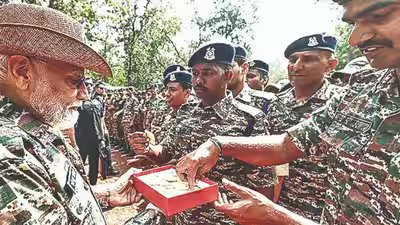

RAIPUR: Prime Minister Narendra Modi on Sunday warned that the end of armed Maoist insurgency did not mean the threat had disappeared, alleging that what he called ‘Dimagi Naxals’ had infiltrated political parties and organisations and were inciting people against the Constitution and democracyContinuing his long-standing tradition of celebrating Diwali with security forces, this time at Karanpur camp in Chhattisgarh’s Bastar – once the epicentre of Maoist insurgency and declared free of Naxalism on March 31 this year – he called for identifying and defeating such elements to safeguard the country.Calling it a historic Diwali after nearly five decades of conflict, Modi said this was the first festival of lights when every district in the country was free from Maoist insurgency. “This is the first Diwali after the country has won its decades-long battle against Naxalism and Maoist terror. This is the first Diwali when every district is free from Naxalism,” he said, attributing the achievement to the courage, sacrifices and dedication of security forces.Modi asserted that for the first time in 47 years, the CRPF had completed a year without losing a single jawan in operational duty.Political will since 2014 drove anti-insurgency success, says PM | page 6He described the milestone as a victory of sound policies, political resolve and the bravery and restraint of security personnel. “More than 1,000 jawans sacrificed their lives in Chhattisgarh”, he said, recalling the scale of Maoist violence, adding there was a time when more than 230 districts across 20 states were affected.From Bihar and Odisha to Maharashtra, Madhya Pradesh, Uttar Pradesh and Chhattisgarh, vast regions had lived under the shadow of violence, he said. “After sunset, life would come to a standstill. People could not step out of their homes. Naxals had even snatched away people’s right to vote,” he said.Modi recalled the April 2010 Dantewada massacre in which 76 CRPF personnel were killed and another attack that year in which he said 44 civilians lost their lives. He accused previous govts of treating the insurgency as an incurable problem and abandoning tribal communities to their fate. “Some had accepted that bullets would continue to fly, jawans would die and innocent people would suffer. No country can confront its enemies with an attitude that things will simply continue this way,” he said.He credited the change in India’s counter-insurgency strategy to the political will demonstrated after his government assumed office in 2014. “We gave our security forces the freedom to take every necessary decision,” he said, adding the govt had taken several national security decisions, including measures not widely known to the public, to disrupt funding networks supporting Maoists and separatist organisations.
Share your thoughts in the comments
Be respectful · TOI community guidelines
He also alleged that elements within the earlier political and administrative system had provided support to Left-Wing Extremism, which his govt worked to eliminate.Linking the decline in insurgency to development, Modi said Maoists had prevented schools, hospitals, medical facilities, mobile towers and industries from coming up in areas under their influence. Modi said the govt had, therefore, pursued security operations alongside a special development campaign.According to him, more than 15,000km of roads had been constructed in areas affected by Naxalism, along with over 9,500 mobile towers. Nearly 175 Eklavya residential schools had been opened for tribal students, while 50 industrial training institutes and approximately 50 skill development centres were established to improve employment opportunities. He also cited the establishment of thousands of post offices, bank branches and ATMs in previously underserved regions.
Discover more from updatview
Subscribe to get the latest posts sent to your email.