



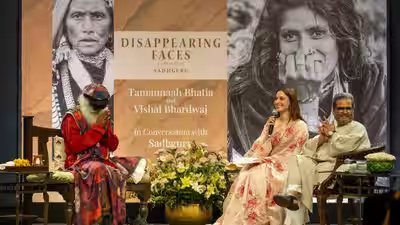

Actor Tamannaah Bhatia and filmmaker Vishal Bhardwaj joined spiritual leader Sadhguru for a discussion on his photo book Disappearing Faces at the Fairmont Hotel in Mumbai on November 22.The conversation covered ageing, individuality, education, devotion and the changing lifestyles of people living in remote Himalayan regions.The book brings together photographs taken by Sadhguru over five decades of journeys through the Himalayas, particularly Nepal and Tibet. The portraits document people and communities whose lives have been shaped by their relationship with the natural environment.During the discussion, Tamannaah spoke about the photographs’ portrayal of ageing and contrasted the acceptance of visible signs of ageing among the people captured in the book with attitudes in urban society.“Why are we not accepting of something that’s the most inevitable, which is the passage of time?” she asked, observing that the people in the photographs appeared more accepting of ageing than those living in cities.Responding to her remarks, Sadhguru said attitudes towards ageing in India had changed in recent times. “This is, I think, a recent happening in India. Otherwise, women and men grew old gracefully in this country. But we have taken Western ideas where the whole civilizations are ruled by hormones,” he said.He added that society had come to place excessive importance on youth and the age associated with peak hormonal activity. “But if you make one aspect of life everything, then you will be a very skewed life,” he said.
Discussion on individuality and education
The conversation also examined the individuality of the people featured in the photographs. Tamannaah noted that despite having fewer resources, education and exposure than their urban counterparts, the people appeared to have distinct personalities and a greater sense of comfort in expressing themselves.Sadhguru linked this to the purpose of education, arguing that it was increasingly focused on preparing people for employment rather than encouraging them to explore their interests and capabilities.“Education should be about expanding our horizons,” he said, adding that many people remained occupied with securing jobs, leaving limited room to explore what they were capable of or inclined towards.Bhardwaj, meanwhile, drew attention to the stillness visible in the faces captured in the book. He referred to Sadhguru’s observation that stillness represented the highest level of intensity and asked how this related to the devotional lives of saints such as Meera and Kabir.Sadhguru explained that Meera’s devotion to Krishna shaped her emotional experiences, allowing her to approach everything with a sense of sweetness. Kabir, he said, sought to balance his inner experiences with the practical demands of everyday life.
Share your thoughts in the comments
Be respectful · TOI community guidelines
He also referred to Krishna as an example of being fully engaged with the world without allowing external circumstances to disturb one’s inner experience.
About ‘Disappearing Faces’
Launched in August, Disappearing Faces is a collection of photographs taken by Sadhguru during his journeys through remote Himalayan regions over five decades.The book focuses particularly on communities in Nepal and Tibet, documenting their faces, lifestyles and experiences.According to the book’s description, the photographs capture ways of life that are changing with the spread of modern development and the influence of the information age.
Discover more from updatview
Subscribe to get the latest posts sent to your email.