


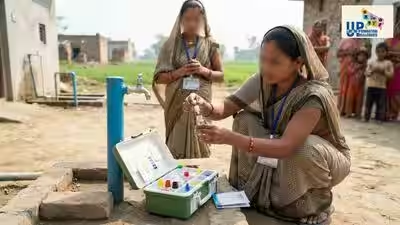




LUCKNOW: Uttar Pradesh’s rural drinking water programme is moving past the installation of household taps. Under chief minister Yogi Adityanath, the state government is giving greater weight to water quality monitoring, community participation and the role of women in protecting a resource every rural household depends on.A key marker of this shift is Uttar Pradesh’s second-place national ranking in water quality testing with Field Testing Kits (FTKs) in 2026–27. As of October 27, 2026, the state had completed 33.95% of its annual testing target, well above the national average of 12.83%. Karnataka led with 69.32%, while Tamil Nadu followed Uttar Pradesh in third place at 28.43%.The ranking matters because it points to a more decentralised way of managing rural water. Rather than relying only on centralised laboratories, the state is training local women to test water in their own villages with FTKs.This brings surveillance closer to households and lets communities take a direct part in checking the safety of what they drink.The programme also has an economic side. With about 4.85 lakh women engaged in testing, it creates livelihood opportunities and strengthens women’s presence in local governance and rural development.Access to drinking water is a basic requirement of rural development, but access alone does not make water safe. Sources can be contaminated by naturally occurring substances, agricultural runoff, poor sanitation and other environmental factors.Unsafe water causes a range of health problems, especially for children, the elderly and other vulnerable groups, and waterborne illness adds to the financial strain on rural families and to the load on public health facilities. With this in mind, the state’s approach rests on three linked priorities: access, quality and regular monitoring.The Jal Jeevan Mission has been the framework for expanding household tap coverage. According to departmental information from November 2026, Uttar Pradesh has given tap connections to more than 2.25 crore rural families, bringing total coverage to roughly 2.672 crore rural homes.Yet the government acknowledges that the number of connections is an incomplete measure of success, because the quality of the water flowing through them counts just as much. Field Testing Kits address this directly.They give villages a practical way to check water quality locally, spot possible contamination early and act in time. The aim is for testing to become a routine part of managing rural water supply rather than an occasional administrative exercise.The scale of the effort reflects how hard it is to monitor drinking water in one of India’s largest states. According to UP Jal Nigam (Rural), Uttar Pradesh has 97,071 villages and has set an annual target of 11,64,852 water quality tests for 2026–27.As of October 27, the state had reached 33.95% of that target, placing it second nationally and far ahead of the 12.83% national average. Karnataka stood at 69.32%, Tamil Nadu at 28.43%, Andhra Pradesh at 24.39% and Assam at 7.30%. These figures place Uttar Pradesh among the country’s top performers in community-based testing.The result carries extra weight given the size of the state’s rural population and the number of villages that need regular monitoring. A programme of this scale depends on coordination among district administrations, rural water supply agencies, village-level institutions and trained community workers.The target of more than 11.64 lakh tests is therefore more than a numerical benchmark. It represents an attempt to build a systematic monitoring network that can detect water quality problems anywhere in the state. Testing continues, and the department is working to meet the full annual target.The defining feature of the programme is its use of Field Testing Kits, which allow a preliminary assessment of water quality at the local level. Traditionally, testing has depended largely on collecting samples and carrying them to laboratories.Laboratory analysis remains essential for detailed scientific work, but relying on it alone makes routine monitoring slow, especially in scattered rural settlements. FTKs add a second layer.Trained personnel can run basic tests near the water source itself, and the kits assess specified quality parameters and flag problems that need closer investigation. Local teams examine samples and report results through the prescribed departmental system.This approach has several practical advantages. It makes monitoring accessible to villages far from district laboratories. It encourages more frequent testing and builds up information on the condition of local sources.It lets the administration spot possible contamination and start follow-up, including confirmatory laboratory tests and corrective measures where necessary. It also gives residents a stake in looking after their own water resources.It is worth being clear, however, that FTK testing is a screening tool and not a substitute for comprehensive laboratory analysis. When a field test suggests contamination, further examination at authorised laboratories and appropriate remedial action are still required.The goal is a system in which field testing, laboratory verification and administrative response work together.
Women’s participation
The most significant social feature of the initiative is the scale of women’s participation. Under the programme, five women in each revenue village are responsible for testing water with FTKs.Across Uttar Pradesh, about 4.85 lakh women have been registered for this work on the Central Government’s Water Quality Management Information System (WQMIS) portal. That makes rural women active participants in managing an essential public service.Women already play a central role in household water management. They typically collect, store and use water for drinking, cooking, sanitation and other domestic needs, and in many communities, they are the first to notice a change in its colour, smell or taste.The programme builds on that familiarity by giving them a formal role in monitoring. Through training and access to testing kits, these women take on a technical responsibility once associated mainly with specialised agencies. Their involvement brings monitoring closer to homes and makes it easier for communities to report concerns to the authorities.It also gives them a chance to learn new skills, take part in community-level decisions and contribute to delivering a basic public service.At this scale, the programme shows how a public infrastructure effort can be tied to women’s empowerment by creating roles that combine community responsibility, skill development and income.A recurring theme in the Yogi government’s approach to rural development has been moving women beyond the role of welfare recipients. Through self-help groups, livelihood missions, financial inclusion schemes and community institutions, women are increasingly encouraged to take part in economic activity and local development.The water testing initiative fits this pattern. Instead of treating women only as recipients of better water facilities, it makes them active monitors of the water supplied to their communities.The change matters for several reasons. Public infrastructure lasts longer when local communities help manage it. Women gain practical technical skills, and their visibility and participation in village-level institutions grow. They also find new ways to contribute to household income and financial independence.The registration of 4.85 lakh women on the WQMIS portal gives the programme an institutional framework for recording and tracking their work. The initiative, then, is not just about handing out kits. It is about building a network of trained community participants who can help manage rural drinking water systems over the long term.For the women involved, the role can also build confidence and earn recognition in their villages.The WQMIS portal offers a digital way to record testing activity. By bringing field-level data into one monitoring framework, it helps authorities track progress against annual targets and compare performance across areas.This matters especially in a state with more than 97,000 villages, where a decentralised programme needs dependable information on how many tests were done, where, and with what results.Digital reporting can improve transparency and make departmental monitoring more systematic. It can also show where testing is lagging and where extra training, equipment or administrative support is needed.Together, Field Testing Kits, trained women and digital reporting form a layered arrangement. Women carry out preliminary tests in the village, results are logged in the designated system, and the administration pursues further investigation and corrective action where necessary.The intent is monitoring that is regular, accessible and responsive. To deliver its full potential, though, the programme must keep several priorities in view: regular training, functional testing kits, quality control and timely action on reported contamination.The testing initiative is one part of the larger change under way through the Jal Jeevan Mission, which seeks to give rural families functional household taps, reducing reliance on distant sources and the daily burden of fetching water.In a state as large and populous as Uttar Pradesh, the expansion has been especially significant. Departmental figures from November 2026 show that more than 2.25 crore rural families have been reached, with total tap coverage at roughly 2.672 crore rural homes.The state also reports 38,317 villages with 100% tap coverage and more than 28,309 villages with Har Ghar Jal certification. Building this network has involved around 5.20 lakh kilometres of pipeline.Even so, creating infrastructure is only part of the task. Keeping systems running, ensuring regular supply and protecting water quality are equally important to the programme’s lasting success, and the focus on testing reflects this move from construction to service sustainability.A household tap can transform daily life, but its real value depends on the water being safe to drink. Regular monitoring can reveal risks before they grow into larger public health problems, and trained women give each village a local means of observing and reporting trouble.Safe drinking water matters well beyond convenience. It is tied to public health, nutrition, children’s development, women’s well-being and the general quality of rural life.For families in remote villages, contaminated water can have serious consequences, particularly where timely testing and treatment are hard to reach. A village-level testing network narrows the information gap by making preliminary assessment easier to obtain. It can also raise awareness about safe storage, regular monitoring and reporting suspected contamination.The focus on women is equally relevant to public health. Because they are closely involved in household water use, they are well placed to spread safe-water practices and to link government agencies with rural homes.The programme thus pursues two aims at once: strengthening quality assurance for drinking water and opening opportunities for women to take part in community development.Second place nationally is an encouraging milestone, but the larger objective is for every rural household to receive water that meets prescribed quality standards. The state must sustain its effort through the year to complete 11,64,852 tests across 97,071 villages, particularly in areas where coverage is still low.The next phase should ensure that testing is not reduced to hitting numbers, since quality, regularity and reliability matter just as much. That calls for continuous training of the women involved, an adequate supply of Field Testing Kits, periodic verification through authorised laboratories and prompt action whenever contamination is found.The digital monitoring system should also be used actively to identify vulnerable areas and sharpen the administrative response. Another priority is keeping the 4.85 lakh registered women engaged and making sure their involvement turns into real livelihood and empowerment gains.The larger vision is a rural water system in which communities are partners, not passive recipients, in protecting public health and maintaining essential infrastructure.Uttar Pradesh’s second-place ranking in FTK-based testing is an important step in strengthening rural drinking water security. Its significance lies in the scale, since monitoring quality across more than 97,000 villages takes an extensive network, effective coordination and sustained community involvement.By engaging about 4.85 lakh women, the Yogi government has added a social and economic dimension to the effort.The initiative shows how a public service programme can address infrastructure needs, community participation and women’s economic engagement together.The wider aim is for safe drinking water to become a dependable household service, for water testing to become a regular village activity, and for women to emerge as stakeholders in rural development.
Discover more from updatview
Subscribe to get the latest posts sent to your email.