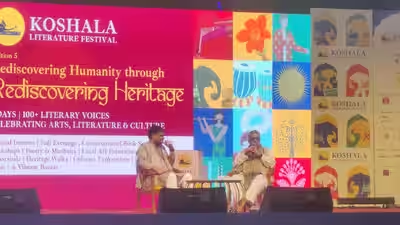


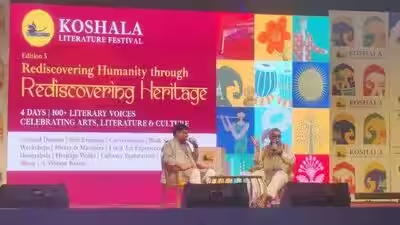


LUCKNOW: Author and literary scholar Purushottam Agrawal on Sunday questioned the tendency to club Vinayak Damodar Savarkar, Subhas Chandra Bose and Bhagat Singh together despite their ideological differences, arguing that such a grouping reflected society’s growing fascination with violence rather than an understanding of their political convictions.Speaking on ‘Gandhi: The Man, The Mahatma’ at the fifth edition of the Koshala Literature Festival, the author of ‘Majbooti Ka Naam Mahatma Gandhi’ said the three leaders were being placed on a common platform primarily because of their emphasis on violence, overlooking their fundamentally different political and ideological positions.“What is common between Savarkar, Subhas Bose and Bhagat Singh? Only the emphasis on violence,” Agrawal said.Questioning the intellectual basis of such a grouping, Agrawal urged people to read Bose’s ‘The Indian Struggle’ to understand his views on Hindutva and examine Bhagat Singh’s ideological positions.He argued that celebrating the three together merely because of their emphasis on violence, irrespective of their political differences, was a disturbing social tendency.“This fascination with violence is not good for any society,” he said.Tracing Hindutva’s political journey, Agrawal said the ideology was on the extreme margins of Indian politics when Savarkar died in 1966, but its followers remained steadfast in their convictions.“Whether you like it or not, Hindutva is the central fact of Indian politics,” he said.Questioning Savarkar’s formulation of nationality based on fatherland and holy land, Agrawal asked whether Hindus settled in the US should similarly be denied citizenship because their holy land was India.
Gandhi’s support for Khilafat movement was a mistake: Agrawal
Scholar Purushottam Agrawal described Mahatma Gandhi’s decision to support the Khilafat movement and link it with the national movement as a mistake, but said Gandhi learnt from the experience.Speaking at the fifth Koshala Literature Festival, Agrawal said Gandhi remained active in Indian politics for another 27 years but never allowed any religious issue, whether concerning Hinduism or Islam, to occupy the centre of politics.He said Gandhi constantly attempted to strike a balance between his spiritual convictions and political judgement, adding that both his successes and failures offered valuable lessons for contemporary society.
‘We all are Gandhi’s progeny’: Ho Chi Minh
Recalling a 1955 conversation between Vietnamese revolutionary Ho Chi Minh and Indian communist leader K Damodaran, author Purushottam Agrawal said Damodaran had asked why communists succeeded in Vietnam but failed to achieve similar political success in India.According to Agrawal, Ho Chi Minh attributed this to Indian communists’ failure to understand Gandhi, while Vietnamese revolutionaries understood his significance despite pursuing an armed struggle.“We all are Gandhi’s progeny,” Agrawal quoted Ho Chi Minh as telling Damodaran. He cited the conversation to highlight Gandhi’s influence beyond India, even among revolutionaries who did not subscribe to his methods of non-violence.
Discover more from updatview
Subscribe to get the latest posts sent to your email.