






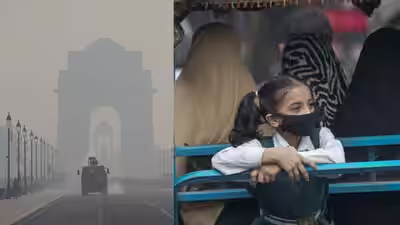

NEW DELHI: By the afternoon of 14 November Delhi’s overall AQI was 363, officially very poor. North Campus, however, recorded 439, Narela 435 and ITO and IIT Delhi 433 each, all falling in the severe zone.That zone starts at 401 the next day, IIT Delhi was at 425, while the city average settled at 352. Which side of that line your neighbourhood sits on shapes your whole day.
The day begins with a number

City’s pollution map
Take for instance a family in Punjabi Bagh where the reading touched 406 on 14 November. The windows are shut and the morning walk is canceled. Commuters are advised to wear a well-fitting N95 outdoors.Under GRAP stage II, parking fees are hiked to discourage use of private cars while Metro and bus frequency is increased. Even the trip to and from is a calculation.
School is a negotiation

Bad air, big impact
After the commission for air quality management imposed GRAP stage III on November 6, Delhi schools moved to hybrid classes up to Class 5 from November 7.It sounds like flexibility but it actually means deciding whether to send a six-year-old out into the smog or find someone to supervise at home. It is this choice that bites hardest for households where both adults work outside.
The waiting room in the clinic
On November 9, some 50 patients with breathing difficulty came to the respiratory OPD at a south Delhi hospital. Its estimated that a up to 75 per cent rise in such cases during times of severe pollution.Doctors say there is an expected increase of 20-30 per cent in respiratory OPD and emergency visits and those in the age group of 20-50 are also complaining of breathing trouble. So a cough means inhalers, a doctor’s visit and often a day off work.
Why does it keep repeating itself

Delhi pollution: In numbers
Fireworks get the blame but the baseline was already bad. CSE found that Delhi’s average PM2.5 in the week before Diwali was 236 µg/m³, a three-year high. This is 97 per cent higher than 2025’s 120 and 32 per cent higher than 2024’s 179.On Diwali day itself, CREA estimates the daily average at 257 µg/m³, the fourth most polluted Diwali since 2016. India’s 24-hour PM2.5 standard is 60.And pollution from neighboring NCR districts accounted for around 54 per cent of Delhi’s PM2.5 in the first eight days of November, so a household can do everything right and still breathe it in.
Seasonal tax
The numbers also swing quickly. The city counted 352 on Sunday morning and 290 by 4pm That’s the real cost of whiplash. Families don’t plan for an average, they plan for the worst reading.Those with purifiers and flexible jobs adapt; those without just take it on the chin.
Discover more from updatview
Subscribe to get the latest posts sent to your email.