


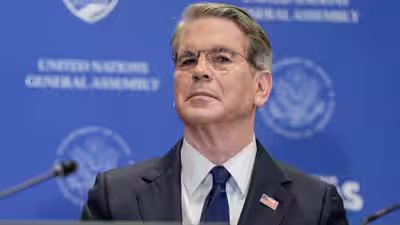

The United States and China must work together to manage the risks posed by advanced artificial intelligence while recognising that their competition for technological leadership will continue, US treasury secretary Scott Bessent said on Tuesday.Bessent said the two countries should not underestimate their differences as they prepare to establish a new dialogue on “superintelligence” during US President Donald Trump’s meeting with Chinese President Xi Jinping in Shenzhen next week.The meeting, scheduled on the sidelines of the November 18-19 Asia-Pacific Economic Cooperation (APEC) leaders’ summit, will be Trump’s third meeting with Xi this year. Bessent, who is due to travel to China for the talks, said Washington wanted to build a relationship with Beijing based on “balance and reciprocity”.“As SI advances, so will the need to engage in new areas of risk management — and to demonstrate how two nations can reconcile the demands of competition with the responsibilities of leadership,” Bessent said in prepared remarks to the National Committee on US-China Relations in New York.He added that the two sides should “harbour no illusions about the differences between the United States and China”, noting that their interests and approaches would not always align.
US and China plan dialogue on superintelligence risks
The proposed dialogue on superintelligence, or SI, is intended to help Washington and Beijing address shared risks and avoid misunderstandings between their respective systems, Bessent said.The discussions are expected to cover the evaluation and testing of advanced AI models before their release, as well as measures to ensure that human judgement remains in control of the technology.“We also expect to exchange best practices for evaluating and testing advanced models before their release, and for keeping human judgment firmly in command of this technology,” he said.The two countries have also agreed to establish a direct communication channel to alert each other about serious incidents involving the technology.Trump and Xi agreed on the AI alert system during their previous meeting at the White House in September. However, Trump had then expressed reluctance to introduce additional safeguards, saying he wanted to protect US leadership in the field, Reuters reported.
Bessent outlines trade initiatives ahead of Trump-Xi meeting
Bessent also referred to trade agreements reached during the two previous Trump-Xi meetings, including plans for a “Board of Trade” to determine reciprocal tariff reductions on $30 billion worth of non-sensitive goods in each direction.China has also pledged to purchase US agricultural products, he said.A proposed “Board of Investment” would provide a structured forum to discuss market access for American companies operating in China and offer greater predictability for Chinese businesses, Bessent added.He acknowledged that the US trade deficit with China remained a point of friction but reiterated that Washington’s objective was to reduce risks in the economic relationship rather than sever trade ties.“The US objective is to ‘de-risk, not to decouple’ from trade with China,” he said.Bessent invoked the first US trade voyage to China in 1784, when American merchants exchanged ginseng for Chinese tea, porcelain and silk, to underline the importance of maintaining areas of cooperation despite competing interests.
Nvidia CEO Jensen Huang faces shareholder lawsuit
Bessent did not refer in his remarks to the controversy surrounding Nvidia chief executive Jensen Huang, who is facing an internal investigation by the company’s board over reports of an affair with Alice Huang, a businesswoman suspected by US intelligence services of having links to Chinese intelligence.China’s foreign ministry has dismissed the espionage allegations as “groundless” and “a smear”. Nvidia has said its board has no reason to believe that US national security or the company’s secrets were compromised, while Jensen Huang has pledged to cooperate with the internal review.The controversy has also prompted a shareholder lawsuit against Nvidia and its chief executive.According to news agency AP, retail investor Mark Kistenmacher filed a complaint in a California court on Monday, accusing the company and Huang of misleading investors about the relationship and its potential implications for national security and Nvidia’s business.The complaint alleges that Nvidia failed to disclose Huang’s relationship with Alice Huang and made misleading statements about its dealings with her company, Singapore-based Megaspeed International. The company had earlier said its compliance team had checked Megaspeed’s activities and found no evidence of wrongdoing, AP reported.The lawsuit seeks unspecified damages and a jury trial on behalf of investors who purchased Nvidia shares between October 9, 2025, and November 8, 2026.Nvidia’s independent directors said on Tuesday that they had appointed the New York-based law firm Wachtell, Lipton, Rosen & Katz to conduct a “thorough and independent investigation” into the matter. Joon H. Kim, a partner at the firm and a former acting US attorney for the Southern District of New York, will lead the inquiry.Trump said on Monday that the FBI was investigating the affair. He also said Huang had told him that he had no idea the woman could be involved in espionage, adding that he did not think the Nvidia chief had reason to worry.Nvidia shares fell 4.3% on Monday, wiping out around $190 billion in market value, and declined a further 5.5% by Tuesday’s close.Huang has acknowledged the affair and apologised to his wife, family and the company in an open letter published on Nvidia’s website.“I support the investigation and will cooperate fully. I love our country and our company. I am committed to protecting NVIDIA and supporting America’s national security,” he said.
Discover more from updatview
Subscribe to get the latest posts sent to your email.