

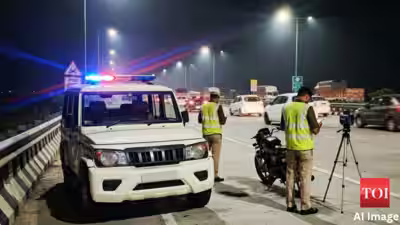

LUCKNOW: Uttar Pradesh Police have booked 29,785 vehicles for overspeeding on expressways across the state during just 21 hours of coordinated enforcement under ‘Operation Safe Speed’, imposing fines totalling Rs 6.06 crore. The statewide drive, launched to curb road accidents and fatalities caused by excessive speed, has exposed widespread violations of speed limits on high-speed corridors, with an average of nearly 1,418 vehicles found speeding every hour of enforcement.Initiated by Director General of Police (DGP) Rajeev Krishna, the campaign is being conducted by the Traffic Directorate under the supervision of Additional Director General of Police (Traffic) A Satish Ganesh. The primary objective is to ensure strict compliance with prescribed speed limits on expressways and discourage dangerous driving through coordinated enforcement, issuance of challans and deployment of speed-detection interceptor vehicles.The campaign was conducted in seven phases between October 26 and November 21, 2026. During each phase, speed interceptors were deployed simultaneously on expressways across different districts for three hours on designated days and during specified time slots. Enforcement was carried out in both directions on expressways to ensure that motorists travelling towards and away from their destinations were checked for violations.The coordinated deployment of interceptors was designed to prevent motorists from escaping enforcement by shifting to another stretch of the expressway and to ensure that speed-limit violations were detected across the road network rather than at isolated locations.Across the seven phases, enforcement teams collectively operated for 21 hours and issued 29,785 challans for overspeeding, imposing penalties amounting to Rs 6,06,73,000. The figures translate into an average of approximately 1,418 challans every hour, highlighting the scale of speeding violations recorded during the special enforcement windows.
Yamuna Expressway records highest number of challans
The Yamuna Expressway accounted for the highest number of overspeeding violations, with 9,922 challans and penalties of Rs 2.09 crore. The Ganga Expressway recorded 4,099 challans involving fines of Rs 78.98 lakh, while the Purvanchal Expressway registered 3,460 violations and penalties of Rs 68.34 lakh.The Agra Expressway recorded 3,446 challans, with fines of Rs 69.58 lakh, while the Delhi-Dehradun Expressway saw 3,067 challans and penalties of Rs 59.74 lakh. The Delhi-Meerut Expressway recorded 1,892 challans, amounting to Rs 37.88 lakh.The Gorakhpur-Purvanchal Link Expressway accounted for 1,429 challans and Rs 31.74 lakh in fines, while the Bundelkhand Expressway registered 1,166 violations and penalties of Rs 24.75 lakh. The Eastern Peripheral Expressway recorded 991 challans and Rs 19.82 lakh in penalties. Another 313 violations were detected on other stretches, resulting in fines of Rs 6.60 lakh.
Vehicles clocked at 171 kmph, 167 kmph and 162 kmph
The enforcement drive also uncovered instances of vehicles being driven at extremely dangerous speeds. At least three vehicles were recorded travelling at 171 kmph, 167 kmph and 162 kmph, respectively.Traffic officials said driving at such speeds drastically reduces the time available to respond to sudden obstacles, unexpected movements of other vehicles or emergencies. As speed increases, the distance required to bring a vehicle to a complete halt also rises significantly, making emergency braking and steering corrections increasingly difficult.Officials warned that excessive speeding not only puts drivers and passengers at risk but also endangers other motorists, particularly on expressways where vehicles travel at high speeds and accidents can have severe consequences.
Winter speed limits revised on major expressways
With winter setting in and fog expected to reduce visibility, the Uttar Pradesh Expressways Industrial Development Authority (UPEIDA) revised speed limits on major expressways with effect from November 15, 2026. Separate speed restrictions have been prescribed for daytime and nighttime driving to reduce accident risks during the winter season.The revised limits apply to the Agra-Lucknow, Purvanchal, Bundelkhand, Gorakhpur Link and Ganga expressways.On the Yamuna Expressway, the Yamuna Expressway Industrial Development Authority (YEIDA) has separately revised speed limits in view of fog and reduced visibility. Light vehicles will be permitted to travel at a maximum speed of 75 kmph, while heavy vehicles will be restricted to 60 kmph. The revised limits will remain in force from November 25, 2026, to February 15, 2027.The Traffic Directorate has directed all districts to ensure that enforcement is carried out strictly in accordance with the speed limits notified and applicable on the respective expressways at the time of checking, taking into account seasonal revisions.
Police issue fog-driving advisory; toll plazas to use PA systems and LED displays
Anticipating an increase in road accidents due to fog and low visibility during the winter months, the DGP’s office issued special directions to traffic authorities across Uttar Pradesh on November 19.Traffic officials have been instructed to use public-address systems and LED display screens at toll plazas on expressways and national highways to alert motorists about fog-related risks and safe driving practices. Drivers are being advised to reduce speed, remain within their designated lanes and avoid unnecessary overtaking.Motorists have also been urged to use low-beam headlights and fog lamps, maintain adequate distance from vehicles ahead and use indicators before stopping or changing direction. The advisory cautions drivers against using mobile phones while driving, playing loud music that could distract them, or driving when tired or sleepy.Drivers have been advised to seek assistance through emergency helplines 112 and 108 in case of accidents or medical emergencies.Authorities have also been directed to coordinate with relevant agencies to ensure the availability of ambulances, medical teams and highway patrols, as well as arrangements for the prompt removal of accident-hit or stranded vehicles. The aim is to minimise secondary collisions, particularly during foggy conditions when visibility can deteriorate rapidly and approaching motorists may not be able to spot vehicles stopped on the carriageway.
Drive to continue beyond challaning, focus on preventing fatalities
The Traffic Directorate said Operation Safe Speed would continue in the coming weeks as part of a sustained effort to curb dangerous driving and reduce road fatalities on the state’s expressway network.Officials said the campaign was not merely intended to generate challans or impose penalties but to create a deterrent against overspeeding and promote responsible driving. Motorists have been urged to adhere to prescribed speed limits, particularly during winter, maintain safe braking distances and adjust their speed according to road and weather conditions.The police have emphasised that reaching a destination quickly should never take precedence over road safety, warning that overspeeding combined with fog and reduced visibility can turn expressways into high-risk corridors.“Safe traffic, safe life” remains the central message of the campaign.
Discover more from updatview
Subscribe to get the latest posts sent to your email.