


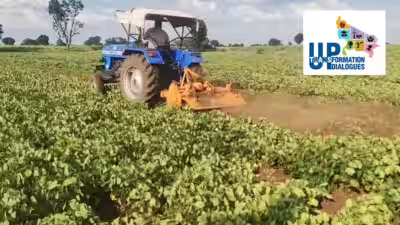

The latest agricultural figures reaffirm Uttar Pradesh’s position as the food basket of India. It is the country’s leading producer of wheat, rice, sugarcane, potatoes and milk, while also contributing significantly to pulses, mustard, bajra, barley, fruits and vegetables.Uttar Pradesh occupies a pivotal position in India’s agricultural economy. It is the country’s largest producer of wheat, rice, sugarcane, potatoes and milk, contributing substantially to national food availability and rural livelihoods. With a population of more than 200 million, the state not only meets a significant part of its own food requirements but also supplies agricultural produce to markets across the country.The latest agricultural estimates for 2025-26 reaffirm this importance. Depending on the official estimation series, Uttar Pradesh accounts for 17.34 percent to 19.92 percent of India’s total foodgrain production and approximately 30 percent to 35 percent of its wheat output. Its contribution extends to pulses, oilseeds, coarse cereals, fruits, vegetables and dairy, making it one of India’s most diversified agricultural economies.The state’s agricultural strength rests on fertile soil, extensive irrigation, diverse agro-climatic conditions and a large farming community. However, improving productivity, diversifying crops and expanding food processing remain important priorities for the next phase of agricultural growth.
An agricultural economy shaped by the Gangetic plains
Agriculture contributes approximately 25.8 percent of Uttar Pradesh’s Gross State Value Added in 2024-25 and remains a major source of employment and rural income. The fertile alluvial plains of the Ganga, Yamuna, Ghaghra and their tributaries provide favourable conditions for cultivation, supported by canals, tubewells and other irrigation facilities.The state’s geographical diversity allows farmers to cultivate a wide range of crops. The Terai region is known for paddy and wheat, western Uttar Pradesh is a major sugarcane and wheat belt, eastern districts are important for rice and pulses, while Bundelkhand offers opportunities for millets, pulses and oilseeds.Uttar Pradesh has approximately 16.5 million hectares of net sown area and around 25.9 million hectares of gross sown area. Its cropping intensity is approximately 157 percent, indicating that a substantial proportion of agricultural land is cultivated more than once annually.Wheat dominates the rabi season, while rice and sugarcane are major kharif crops. Pulses, oilseeds, maize, bajra and barley further diversify the state’s agricultural basket.
Foodgrain production: A major contributor to national food security
Uttar Pradesh is India’s largest foodgrain-producing state, with a substantial lead over other major agricultural states.According to the Union Agriculture Ministry’s Third Advance Estimates for 2025-26, released on May 27, 2026, India’s foodgrain production reached a record 376.56 million tonnes, compared with 357.73 million tonnes in 2024-25. Rice production was estimated at 154.03 million tonnes, wheat at 120.66 million tonnes and maize at 55.09 million tonnes.The Crop-wise Production workbook provides two estimates for Uttar Pradesh for 2025-26. According to UPAg, the state produced 65.31 million tonnes of foodgrains, including 62.21 million tonnes of cereals and 3.10 million tonnes of pulses. This represents 17.34 percent of national production.The Uttar Pradesh Agriculture Department estimates production at a higher 75.02 million tonnes, comprising 71.48 million tonnes of cereals and 3.55 million tonnes of pulses, equivalent to 19.92 percent of India’s total. These are two separate advance estimates and should not be combined. The difference reflects variations in estimation and compilation methodologies. Final figures are awaited.For comparison, the Economic Survey 2025-26 recorded Uttar Pradesh’s foodgrain production at 63.85 million tonnes in 2024-25, accounting for 17.85 percent of national output. On the UPAg basis, the state’s production increased by approximately 2.3 percent in 2025-26, although its national share declined marginally because overall Indian production grew faster.The state’s own production series had placed its 2024-25 foodgrain output at approximately 73.74 million tonnes. Despite differences between the two reporting systems, Uttar Pradesh’s leadership is undisputed. In 2024-25, Madhya Pradesh ranked second with 46.63 million tonnes, followed by Punjab with 32.78 million tonnes.The state’s foodgrain production has also expanded considerably over the decades, increasing from 24.95 million tonnes in 1980-81 to approximately 73.74 million tonnes in 2024-25 on the state series.
Wheat: Nearly one-third of India’s production
Wheat is the most important rabi crop in Uttar Pradesh and a major contributor to India’s food security. Fertile soil, favourable winter conditions and extensive irrigation have established the state as the country’s leading wheat producer.According to the 2025-26 workbook, UPAg estimates the state’s wheat production at 35.88 million tonnes, representing 29.73 percent of India’s total production of 120.66 million tonnes. The Agriculture Department estimates it at 42.28 million tonnes, equivalent to 35.04 percent of national output.In 2024-25, Uttar Pradesh produced 35.65 million tonnes of wheat, accounting for 30.23 percent of India’s production. Madhya Pradesh ranked second with 24.51 million tonnes. The UPAg estimate indicates a marginal increase of around 0.6 percent in 2025-26 over the previous year. Since national production increased by approximately 2.3 percent, the state’s share declined slightly.Wheat cultivation covers approximately 9.61 million hectares in Uttar Pradesh. Based on the UPAg production estimate, average productivity works out to around 3.7 tonnes per hectare, indicating further scope for improvement through improved seeds, scientific cultivation and efficient water management.Government procurement provides an important support mechanism. During the 2025-26 rabi marketing season, the state procured more than 10.27 lakh tonnes of wheat, compared with 9.31 lakh tonnes in the previous year. More than two lakh farmers participated, receiving approximately Rs2,508 crore directly into their bank accounts. Mobile procurement centres helped extend government purchasing facilities to villages.
Rice: A leading position in area and production
Rice is another major pillar of Uttar Pradesh’s agricultural economy, particularly in its eastern and central regions. The state has emerged as India’s largest rice-producing state, overtaking West Bengal in recent years.In 2024-25, Uttar Pradesh produced 20.76 million tonnes of rice, representing 13.82 percent of national production. Telangana followed with 17.45 million tonnes and West Bengal with 16.02 million tonnes. For 2025-26, UPAg estimates the state’s rice production at 19.81 million tonnes, accounting for 12.86 percent of India’s total of 154.03 million tonnes. The Agriculture Department places production higher at 21.56 million tonnes, representing 14 percent of national output.The two estimates indicate different year-on-year trends. The UPAg figure represents a decline of approximately 4.6 percent over 2024-25, while the Department’s estimate indicates an increase. Therefore, the direction of change should be understood in the context of the particular series.Uttar Pradesh has approximately 7 million hectares or more under paddy cultivation. Based on the UPAg production estimate and the available area figure of 6.98 million hectares, productivity works out to around 2.8 tonnes per hectare, compared with the national average of approximately 2.92 tonnes. Improving rice productivity offers considerable scope for increasing output without expanding cultivated land.Procurement has remained strong. During the 2025-26 kharif marketing season, the state purchased 62.30 lakh tonnes of paddy against a target of 60 lakh tonnes, paying farmers nearly Rs15,000 crore. More than 4.09 lakh farmers participated, compared with 3.74 lakh in the previous year. The production target for the 2026 kharif season has been fixed at 224.25 lakh tonnes.The state also grows Basmati and several aromatic traditional rice varieties, particularly in western districts, offering opportunities in premium domestic and export markets.
Pulses and oilseeds: Strengthening agricultural diversification
Pulses are essential for nutritional security and reducing India’s dependence on imports. Uttar Pradesh is among the country’s leading pulse-producing states, although there remains considerable potential for expansion.In 2024-25, the state produced approximately 3.08 million tonnes of pulses, ranking fourth nationally and accounting for around 12 percent of India’s total production of 25.68 million tonnes.For 2025-26, UPAg estimates pulse production at 3.10 million tonnes, equivalent to 11.30 percent of India’s 27.41 million tonnes. The Agriculture Department estimates 3.55 million tonnes, representing 12.95 percent of national output.Gram, lentil, urad, tur and moong constitute the principal pulse crops. According to UPAg, gram production stood at 9.44 lakh tonnes, lentil at 7.32 lakh tonnes, urad at 3.29 lakh tonnes, tur at 2.67 lakh tonnes and moong at 2.17 lakh tonnes. The Department’s corresponding estimates were 10.62, 7.69, 3.84, 4.66 and 2.25 lakh tonnes, respectively.Uttar Pradesh has a particularly strong position in lentil production, contributing approximately 41.57 percent of India’s output according to UPAg. Its share in urad production is around 15.22 percent. The government is encouraging pulse cultivation through improved seeds, free seed mini-kits and expansion of the cultivated area. More than 1.05 lakh quintals of certified pulse seeds were distributed during 2025-26. The state aims to increase pulse cultivation by approximately 20 percent, taking the area towards three million hectares.Oilseeds offer another important opportunity. Uttar Pradesh is a major producer of rapeseed and mustard, ranking second nationally in 2024-25 with approximately 2.41 million tonnes, representing around 19 percent of India’s production.For 2025-26, UPAg estimates rapeseed and mustard production at 2.65 million tonnes, equivalent to 19.27 percent of India’s total of 13.77 million tonnes. The Agriculture Department estimates production at 2.98 million tonnes, representing 21.66 percent.Total oilseed production is estimated at 3.44 million tonnes by UPAg and 4.49 million tonnes by the Agriculture Department, accounting for 7.99 percent and 10.42 percent of national production, respectively.Other oilseeds include groundnut, sesame, linseed and soybean. According to UPAg, production stood at 4.62 lakh tonnes for groundnut, 2.16 lakh tonnes for sesame, 0.51 lakh tonnes for linseed and 0.55 lakh tonnes for soybean.The government has set a target of increasing oilseed production to 4.8 million tonnes in 2026-27, supported by five million free seed kits and approximately Rs950 crore in subsidies for seeds and machinery. The target represents different growth requirements depending on which 2025-26 estimate is used, making final figures particularly important.
Maize, millets and barley: Expanding the crop basket
Uttar Pradesh also contributes significantly to the production of coarse cereals and other crops. These are important for nutritional security, animal feed and industrial applications.Maize is gaining importance because of growing demand from the poultry feed and ethanol industries. In 2025-26, UPAg estimates the state’s maize production at 3.05 million tonnes, representing 5.53 percent of India’s total of 55.09 million tonnes. The Agriculture Department estimates production at 3.78 million tonnes, equivalent to 6.86 percent.Bajra is a stronger crop for the state. Production is estimated at 2.31 million tonnes by UPAg and 2.53 million tonnes by the Department, representing 21.31 percent and 23.32 percent of national production, respectively.UPAg places jowar production at 0.52 million tonnes, accounting for approximately 11.99 percent of national output.Uttar Pradesh also has a substantial share in barley production. Its 2025-26 output is estimated at 6.15 lakh tonnes by UPAg, representing 34.26 percent of India’s total production of 17.95 lakh tonnes. The Agriculture Department estimates it at 7.19 lakh tonnes, equivalent to 40.06 percent.The state’s kharif planning for 2026 has placed additional emphasis on bajra, maize, arhar and groundnut alongside paddy. Greater diversification towards these crops can improve agricultural resilience and create additional income opportunities.
Sugarcane: The backbone of the rural industrial economy
Sugarcane is one of Uttar Pradesh’s most important commercial crops, connecting agriculture with the sugar, ethanol and allied industries.The state produced approximately 245.35 million tonnes of sugarcane in 2024-25, accounting for nearly 48.6 percent of India’s total production, according to IBEF’s state profile. The national sugarcane crop was estimated at a record 500.06 million tonnes in 2025-26.Western and central Uttar Pradesh are the principal sugarcane-growing regions, with districts such as Meerut, Saharanpur, Bareilly and Bulandshahr playing an important role.Agricultural productivity has improved considerably. Average sugarcane yield increased from 72.38 tonnes per hectare to 83.25 tonnes per hectare over approximately nine years. At the same time, cultivated area declined from around 23.3 lakh hectares in 2024-25 to approximately 22.57 lakh hectares in 2025-26.During the 2025-26 crushing season, 121 sugar mills crushed approximately 877.96 lakh tonnes of sugarcane and produced around 89.5 to 89.7 lakh tonnes of sugar. Average sugar recovery improved to 10.21 percent, compared with 9.7 percent in the previous year.Mills had paid approximately Rs31,682 crore to sugarcane farmers, representing 91.64 percent of the cane price due at the latest reported update.However, the volume of cane crushed has declined from 1,016 lakh tonnes in 2021-22 to 956 lakh tonnes in 2024-25 and around 878 lakh tonnes in 2025-26. Maharashtra had overtaken Uttar Pradesh in cane utilisation for sugar and ethanol by mid-July 2026, indicating the need for further improvements in processing capacity and industrial efficiency.Ethanol production provides an additional opportunity. A secondary industry estimate credits Uttar Pradesh with approximately 42 percent of India’s ethanol output in 2023-24, or around 180 crore litres.The future of the sugar industry will increasingly depend on higher recovery rates, modernisation of mills, ethanol production and better utilisation of available cane.
Fruits and vegetables: Leadership in potato and mango production
Horticulture is an important and expanding component of Uttar Pradesh’s agricultural economy. According to the Agriculture Ministry’s final estimates, India’s horticultural production reached approximately 370.7 million tonnes in 2024-25, including 217.8 million tonnes of vegetables and 117.6 million tonnes of fruits.Uttar Pradesh is among the country’s leading horticultural producers and is particularly prominent in potatoes, mangoes, guava, aonla, peas and other vegetables. Potato is the state’s most important horticultural crop. Uttar Pradesh produced an estimated 203.8 lakh tonnes in 2024-25, representing approximately 35 percent of India’s total production of 585.7 lakh tonnes. Average productivity was around 29.2 tonnes per hectare, among the highest achieved by major potato-producing states.Agra is a major production centre, contributing approximately 28 lakh tonnes annually. Hathras, Firozabad, Kannauj, Aligarh, Farrukhabad, Mainpuri and Etawah are also important potato-growing districts.Mango is another major strength. Uttar Pradesh produced approximately 5.99 million tonnes in 2023-24, accounting for roughly one-fourth of national production according to earlier estimates. Malihabad near Lucknow is famous for Dusheri mangoes, while Saharanpur, Unnao, Sitapur, Meerut and Moradabad are other important production centres.The state is also known for varieties such as Chausa and Langra. Banarasi Langda mango and Allahabad Surkha guava have Geographical Indication recognition. Total fruit production increased to approximately 14.7 million tonnes in 2024-25, compared with 13.5 million tonnes in the previous year.Vegetable production was approximately 34.4 million tonnes in 2023-24, led by potato, peas, cabbage, tomato and okra. Earlier state-level assessments placed Uttar Pradesh second in overall vegetable production, with around 14.1 percent of national output, and third in fruit production, with approximately 10 percent.Despite its production leadership, food processing remains an area requiring greater investment. The state ranks first in mango and potato production but sixth in their processing. Expanding cold chains, grading, packaging, storage and food processing facilities can reduce post-harvest losses and improve farmers’ returns.Mango pulp, aonla products, potato-based foods and cereal processing offer considerable investment and employment opportunities.
Milk production : India’s largest dairy-producing state
Dairy farming is another important source of income for rural households in Uttar Pradesh. It complements crop cultivation and provides a relatively regular source of income, particularly for small and marginal farmers.According to the Basic Animal Husbandry Statistics 2025, India’s milk production reached 247.87 million tonnes in 2024-25, an increase of 3.58 percent over the previous year.Uttar Pradesh retained its position as India’s largest milk-producing state, contributing 15.66 percent of national production. Rajasthan followed with 14.82 percent, Madhya Pradesh with 9.12 percent, Gujarat with 7.78 percent and Maharashtra with 6.71 percent.The state’s contribution translates into approximately 38.8 million tonnes of milk annually, compared with around 27.7 million tonnes in 2016-17 according to an industry estimate.Buffalo milk accounts for a substantial proportion of production. Much of the state’s dairy output comes from small household units maintaining one to three animals. This makes dairy farming an important supplementary activity for agricultural families.The sector supports livestock rearing, fodder cultivation, veterinary services, milk collection, transportation and processing industries. Better chilling facilities, organised collection networks, improved animal health services and modern dairy plants can further strengthen the state’s position.India’s per-capita milk availability increased from 319 grams per day in 2014-15 to 485 grams in 2024-25, reflecting the expansion of the national dairy sector. Uttar Pradesh remains a major contributor to this achievement.
Uttar Pradesh: A pillar of India’s food security
The latest agricultural figures reaffirm Uttar Pradesh’s position as the food basket of India. It is the country’s leading producer of wheat, rice, sugarcane, potatoes and milk, while also contributing significantly to pulses, mustard, bajra, barley, fruits and vegetables.For 2025-26, foodgrain production is estimated at 65.31 million tonnes by UPAg and 75.02 million tonnes by the Agriculture Department. Wheat production is estimated at 35.88 million tonnes and 42.28 million tonnes, respectively, while rice production stands at 19.81 million tonnes and 21.56 million tonnes.Outside foodgrains, the state’s contribution to sugarcane, potato and milk production further strengthens its national agricultural importance.These achievements reflect the contribution of millions of farmers and rural households whose work sustains India’s food supply chain. The next stage of agricultural development will depend on improving productivity, diversifying crops, strengthening markets and expanding processing infrastructure.Uttar Pradesh has established its position through the scale and diversity of agricultural production. The larger opportunity now is to transform this production strength into higher farmer incomes, greater value addition and a more sustainable agricultural economy.
Discover more from updatview
Subscribe to get the latest posts sent to your email.