




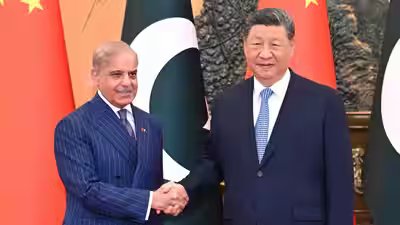

NEW DELHI: A US congressional commission has warned that China’s growing military partnership with Pakistan is increasing the risk of a two-front security challenge for India. It has urged Washington to deepen operational defence cooperation with New Delhi, particularly in the Indian Ocean region, news agency ANI cited report.In its report, the US-China Economic and Security Review Commission (USCC) said Beijing’s expanding military and security support for Islamabad had made the possibility of a two-front conflict an increasingly pressing concern for India.In a chapter titled “China’s Other Front: India and the Future of US Strategy in the Indo-Pacific,” the commission examined China’s growing strategic presence in South Asia and its implications for India’s security and the broader regional balance of power.Referring to the May 2025 India-Pakistan military conflict, which followed the Islamabad-sponsored Pahalgam terror attack that killed 26 people, the report said the episode highlighted how China could support Pakistan during a crisis without directly entering the conflict.India had launched Operation Sindoor in response to the attack, targeting terror infrastructure in Pakistan and Pakistan-occupied Kashmir.The commission said China’s backing for Pakistan could complicate India’s military planning and increase the challenges it would face in any future conflict with its western neighbour.According to the report, Beijing views India’s growing influence as a strategic challenge and uses military, economic and maritime pressure to limit its rise. It also described India as one of the few countries outside the US alliance system with the demographic, economic, military and geographic strength to influence the long-term balance of power with China.Highlighting India’s position as the world’s most populous country, largest democracy and a nuclear-armed state with one of the world’s largest militaries, the commission pointed to its strategic geography. India shares a 2,100-mile contested border with China and is located along key Indian Ocean sea lanes that carry a significant share of China’s energy supplies and trade.While the Western Pacific remains the main arena of US-China rivalry, the report said India presents Beijing with another strategic challenge, both on land and at sea.However, the commission also acknowledged that India’s approach to China is driven by its own strategic interests and commitment to “strategic autonomy”. It cautioned that stronger India-US ties would not necessarily mean New Delhi would align with Washington on every broader foreign policy objective.For Washington, the report said, a stronger India could help create a more favourable balance of power in Asia and provide an alternative to China in manufacturing and global supply chains.
China’s growing presence in Indian Ocean
The report also flagged China’s expanding naval and surveillance presence in the Indian Ocean, saying it could test India’s traditional strategic advantages in the region and place additional operational pressure on its armed forces.It said Beijing was developing infrastructure and logistical support to sustain longer naval deployments, while Chinese naval, surveillance and research vessels were operating closer to India and strategically important sea lanes.The commission further said China was applying elements of its South China Sea approach to the Indian Ocean. It cited Beijing’s references to historic rights and the renaming of undersea features, which it said could lay the groundwork for more assertive actions or potential jurisdictional claims in the region.To counter China’s growing presence, the commission recommended that the US Congress direct the US secretary of defence and the chairman of the Joint Chiefs of Staff to work with India to strengthen undersea and maritime domain awareness across the Indian Ocean.It called for cooperation to move beyond periodic military exercises towards more sustained operational coordination. This could include regular intelligence and surveillance sharing, joint tracking of Chinese naval and submarine movements, and better procedures to respond to maritime threats.The report also recommended setting up an Indo-American Strategic Leadership Exchange Program to develop long-term connections among emerging defence, government, business and academic leaders from the two countries.
India-China ties and boundary dispute
The report’s observations come amid efforts by New Delhi and Beijing to stabilise bilateral ties and address their longstanding border dispute.Earlier in September, Prime Minister Narendra Modi and Chinese President Xi Jinping met on the sidelines of the 18th Brics Summit in New Delhi. The two leaders expressed commitment to finding a fair, reasonable and mutually acceptable resolution to the boundary question and agreed that bilateral relations should be viewed from a strategic and long-term perspective.According to the MEA, the leaders “reaffirmed that both countries should take a strategic and long-term perspective of their ties.” PM Modi emphasised that “differences should not become disputes” and that both sides must be guided by “mutual respect, mutual sensitivity and mutual interest.”The prime minister also stressed that peace and tranquillity along the border remained essential for the continued development of bilateral relations. He underlined the need for both countries to follow existing agreements and understandings on border-related issues.“The two leaders expressed commitment to a fair, reasonable, and mutually acceptable resolution of the boundary question proceeding from the political perspective of their overall bilateral relations and the long-term interests of the two peoples,” the MEA said.
Share your thoughts in the comments
Be respectful · TOI community guidelines
Xi said India and China should view their relationship from a strategic perspective and keep the long-term development of bilateral ties in mind. He added that although the two countries were different, they had been able to “support and help each other to achieve common development.”The Chinese president also highlighted the shared position of India and China as the world’s most populous countries and members of the Global South, saying both had important responsibilities in advancing a shared future for humanity.
Discover more from updatview
Subscribe to get the latest posts sent to your email.