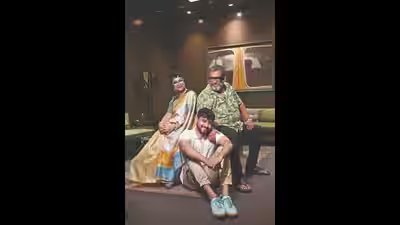

We hosted a leisurely adda with one of Tollywood’s most talented families who have been in the news for their storytelling, acting and filmmaking. If Kaushik Ganguly’s Aajo Ardhangini carries forward the world of his successful Ardhangini starring Churni Ganguly, his son Ujaan made his directorial debut with Katukutu Buro, an unusual Bengali drama-thriller that folds childhood trauma, fantasy, social darkness and a vigilante alter ego into one deliberately slippery universe.With the three of them together, the adda travelled beyond cinema, through creativity, family rules, independence and nepotism before arriving, inevitably, at maccher bazaar and a refrigerator that has apparently had enough. Excerpts:

A still from Aajo Ardhangini
All three of you have been in the news for your work, and now Ujaan has entered filmmaking in his own right. What does this phase feel like for the family?Churni: Before we go on the floor, there are several sessions from morning till night where we sit with the script, the storyline, the dialogues and everything in between. It becomes like a workshop. Kaushik and I have been doing this for a very long time, and Ujaan has grown up watching us. Now that he has joined us as a filmmaker, it has become a learning experience for him as well. I think that reflects in his film too.Kaushik: Amra etake “round table conference” boli. We actually have a round dining table where we sit for hours discussing everything. In between, we get up only for essentials and to eat. This process happens in phases for every film and it also means all of us know each other’s films and texts extremely well.What we do not know is what happens on the floor – the execution. That remains unknown to everyone else. It was the same during Churni’s film, and it was the same during my film. When Ujaan was shooting his film, we were not allowed on set.Churni had a special appearance in the film, so she went to the set for three or four days. But I was not allowed to enter at all. Ujaan had even said before starting the film that I would not be involved in any part of the making process.I told him, “Whatever you do, people will say your father helped you.” But after watching the film, I had to salute him as a director.Churni: Ujaan always maintained, “Whatever mistakes I make or whatever I do right, let me take responsibility for it.” And when I watched the film, I realised he truly stood by every decision he had made.Ujaan, why was it important for you to keep your father away from the set?Ujaan: The biggest factor was his extraordinary persistence. There were two instincts at play. One was my instinct as a filmmaker. When someone new is trying to create something, there are moments where, perhaps because of a lack of experience, certain decisions might be made faster or more instinctively.But if he had been on set, as a director, he would inevitably have influenced things in some way. It could have helped me at certain moments, but it could also have meant that his creative vision would somehow enter the process. I wanted to experience this journey independently. Besides, we are extremely close. We are constantly involved in each other’s lives. The impact of that closeness coming onto the set was something I wanted to avoid.

Churni with a young Ujaan
Churni: We have few rules. We do not call each other while on shoot, and neither do we stay in the same rooms.Kaushik: I am a control freak. But in this case, I was not allowed to enter the set, and it was extremely difficult for me. He would be shooting till 4 am, and I would be awake too.Ujaan: Baba would call members of the assistant director’s team and try to find out how things were going. Sometimes I would catch my assistants on the phone with Baba because their body language would completely change!Ujaan, how has your relationship with your parents evolved over the years?Ujaan: Baba was extremely busy with his films and with establishing himself as the filmmaker he is today. We watched that journey growing up. It required immense hard work. I saw that journey, but I was studying and living my own life. Ma, on the other hand, sacrificed a lot of her career to be there for me while I was growing up. Naturally, my attachment with her became the strongest.But interestingly, when I first moved away from home, when I went to Oxford to study, the natural assumption would have been that Ma would be the one calling me frequently to ask how my studies were going and how I was feeling.But no. She never called me from her end. At most, she would send me a message asking, “How is everything?” I would reply, “I’ll call you sometime.”On the other hand, Baba would call me constantly – before dinner, after dinner, before class, during class and after class. Even if I put my phone on silent, he would keep calling.Everyone in my friend circle knows that “Hello, Baba, bolo” is a very traditional phrase they have heard me say repeatedly, even when I am not chatting with them.When you watched Katukutu Buro, what did you see as parents that perhaps you would not have seen simply as filmmakers?Kaushik: I saw the little boy who used to sit quietly in his baby cot for hours, looking through the window at the shiuli trees. He would not cry or demand attention. He would simply sit there, lost in thought.Churni: I always believed in giving a child that space, without excessive hand-holding. I was always rock steady beside him, and he knew that.Kaushik: Now I see that same child’s imagination expanding on screen. He has given me a completely different universe, one I did not expect to enter.As a filmmaker, that has challenged me too. Will we continue making the same kind of films forever, or recognise that there are vast new worlds waiting to be explored? I feel the universe Ujaan has created has made me want to explore more as a filmmaker too.Churni, you have worked extensively with Kaushik, and now with Ujaan. What changes when the person directing you is your son?Churni: It was actually a very sweet feeling. Kaushik has directed me many times, but this was different. The character was not easy and he wanted me to appear in a completely different avatar.Apart from the emotional aspect, hearing him say “action” and “cut”, and hearing him explain how he wanted me to approach a scene, was a beautiful feeling. It was very wholesome. I was not emotional or crying on set. It was simply a very wonderful experience.

Churni in a still from Nirbashito
In Aajo Ardhangini, some viewers felt that certain dialogues towards the end sounded as though they had been written by a woman. Do you think sensitivity to a character is independent of gender?Kaushik: I believe every person has a feminine side within them. The extent to which someone respects and understands women determines how deeply they can enter their world and understand their struggles, difficulties and emotions.For that, one does not need to be a woman. Similarly, Churni can write a male character’s dialogue extremely well.There was a time when people said that Rituparno Ghosh understood women’s minds very well. There are filmmakers who can intuitively understand a particular emotional state and capture what a person might be feeling at that moment.That comes from love, respect and attention towards women. It has nothing to do with being male or female.

The Gangulys
Kaushik cried after watching Ujaan’s film. He had been worried that if the film did not work, he would carry the guilt of insisting that he return to India, without completing his PhD. When he realised Ujaan had made a good film, he was relieved and emotional
Churni Ganguly
Churni: I did improvise here and there. But obviously with his permission. Improvisation does not mean that I say whatever I want. I would ask him, “Can I say this? Can I add this line?” If I felt that it stayed true to the character and the mood, and if it elevated a thought in some way, then we would discuss it. After that, we incorporated certain things in places.But essentially, the entire script and the line of thought belonged to him.Your dialogues often become part of the audience’s memory. Do you know while writing when you have found one of those lines?Kaushik: Ninety eight per cent of the audience are scriptwriters themselves. The moment they start watching a film, they are also writing a parallel script in their minds. They keep predicting what can happen and what cannot happen. They have already written the sequel in their heads.A good scriptwriter’s challenge is to think of all the possibilities and offer them something they did not anticipate. The film becomes successful when the audience is stumped.Nobody could predict what would happen at the end of Aajo Ardhangini because that was not the most obvious possibility they had considered.For example, when I wrote “Prakton stri mahajoner moto. Se jane, se tar capital-ta kono din-i pabe na.” I realised that the line would resonate.It is also very important to know kaar jannye ami ki likhchi. When I write for Jaya Ahsan, I need to know whether it will work for her. I have always said that I write dialogues after casting because I want to imagine the dialogue coming from that particular face.Finally, the question of nepotism inevitably follows a family like yours. How do you see that debate?Kaushik: The word “nepotism” has been created to describe situations where the next generation benefits from the previous one. This conversation will continue. But we never thought about it that way. When Churni made Nirbashito, people said I must have helped her. When I made Arekti Premer Golpo, they said Rituparno Ghosh had made it happen. Ultimately, audiences watch the work and decide whether it has its own identity. After Katukutu Buro, people understood that it belongs to a completely different universe created by Ujaan.Ujaan: It would have been a difficult conversation if I was not capable of making a film independently. If someone has their own language and strengths, the argument becomes weaker. That independence is important.Churni: What matters is dignity and trust. People observe that. And there is a fundamental problem with the word “nepotism” because it is not used in other professions in the same way. Every business family passes things down to the next generation. Why only filmmakers?In our field, an opportunity is only the beginning. After that comes performance and audience acceptance. Even if someone gets the first few chances because of their background, they are ultimately on their own. Unless they create their own identity and earn acceptance, it does not take them anywhere.What does an off day look like in the Ganguly household, when there are no films to make and no sets to rush to?Kaushik: I know one thing, “Ami bazaar giye maach kini!”Ujaan: Baba is the most unhinged grocery shopper I have ever seen. Whenever he goes to the bazaar, it’s a nightmare for my mother. Instead of bringing home one month’s worth of groceries, he returns with enough for two-and-a-half months. It’s a nightmare for her. The fridge just gives up. The fridge has broken down three times in two months.Churni: Honestly, our holidays are much more mundane than people would imagine. Many times, we discuss stories, ideas and have long adda sessions. There is also a lot of household planning and everyday things that need to be taken care of. We hardly get time to do those.Ujaan: But there is plenty of adda, too. We also love watching things together. Ma and I have started watching House of the Dragon.– Inputs by Ruman Ganguly and Raima GangulyMaking Kurukshetra was a life-changing experience for me, reveals Ujaan

A still from Kurukshetra
Ujaan confesses that making the animated feature, Kurukshetra, was a life-changing experience for him. “Handling a medium like animation with more than 700 people working on the same project was extraordinary,” he says. “Everything is created from scratch – from the script level to storyboards, animation, sets, colours, lighting and every visual detail. It was especially exciting for me because I was always an enthusiastic cartoonist in school. I used to draw and create my own graphic novels. I loved animation and always had an inclination towards it.”He adds that working on Kurukshetra “allowed me to establish myself in the animation industry to some extent, and I hope to continue working in that field.”On the subject of nepotism, he tells us, “I think it would have been a difficult conversation if I was not capable of making a film independently. When I made Kurukshetra, that was completely my own experience. It was different. If someone has their own language and strengths, then the argument (about nepotism) becomes weaker. That independence is important.”
Whenever I see a Bengali film where someone has created a new language, a different vision and a new way of storytelling, I feel deeply emotional if I am able to recognise that. And in case of Katukutu Buro, the emotion was doubled because my son had created it
Kaushik Ganguly
From Sukumar Ray to K2

Ujaan in Katukutu Buro
Ujaan says he became convinced about the idea of Katukutu Buro around the end of 2022 (he wanted his father to make the film, but he was not convinced), when he was studying nonsense verse, limericks and related forms for his coursework and returned to Sukumar Ray’s Katukutu Buro. “On the surface, it is playful and entertaining, but I began seeing a darker subtext,” he says, adding that he started thinking about “how many ‘Katukutu Buros’ exist in our lives, especially for children”. The thought led him to explore patriarchy, masculinity and abuse, a subject he feels is “something we do not speak about enough, particularly when it comes to boys”. He wanted to take the traditional image of the superhero — physically powerful, angry and vengeful — and combine it with vulnerability and trauma. At the same time, he was keen to retain the nonsense of Sukumar Ray’s poem through humour, unusual editing and comic relief. “Even the courtroom scene creates an enclosed world of nonsense that reflects the contradictions of patriarchy,” he explains. K2, the toy, becomes central to this idea, representing “the silence, the wound that is screaming”. Part superhero, part imaginary friend and part childhood toy, K2 expresses everything Kedar cannot. Ultimately, Ujaan sees the superhero journey as an inward one — “it is about confronting the parts of ourselves we have been unable to express”.

When I went to Oxford to study, Ma never called me from her end. At most, she would send me a message asking, ‘How is everything?’ But Baba would call me constantly. My friend circle knew ‘Hello, Baba, bolo’ as a very traditional phrase I’d say repeatedly
Ujaan Ganguly
Discover more from updatview
Subscribe to get the latest posts sent to your email.