




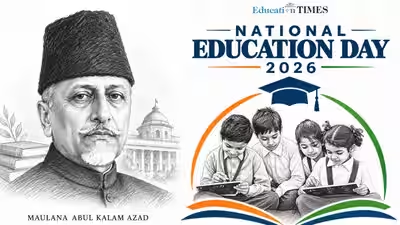

India observes National Education Day every year on November 11 to mark the birth anniversary of Maulana Abul Kalam Azad, the country’s first Education Minister after Independence. The day recognises his contribution to building India’s education system and strengthening institutions of higher learning in the years following Independence.Azad, who served as Education Minister from 1947 to 1958, played an important role in shaping India’s approach to education, scientific research and technical learning. His tenure saw the development of institutions and initiatives that later became central to the country’s higher education framework.National Education Day also serves as an occasion to highlight the importance of accessible and inclusive education. Schools, colleges and educational institutions across the country mark the day through activities that encourage students to understand the role of education in individual development and nation-building.
National Education Day 2026: Why is November 11 celebrated?
November 11 was chosen to commemorate the birth anniversary of Maulana Abul Kalam Azad, who was born on November 11, 1888. As India’s first Education Minister, Azad was associated with several initiatives aimed at expanding educational opportunities and strengthening the country’s academic institutions.His contribution extended beyond the administration of the Education Ministry. He advocated scientific and technical education, promoted research, and supported the development of universities and institutions that could help India build its capabilities after Independence.The observance of National Education Day is therefore linked to his vision of education as an essential foundation for social progress and national development.
Who was Maulana Abul Kalam Azad?
Maulana Abul Kalam Azad was a freedom fighter, journalist, scholar, and educationist who became India’s first Education Minister after Independence. He held the position from August 1947 until his death in February 1958, making him one of the longest-serving heads of the ministry.Born in 1888, Azad developed an interest in literature, religious studies, and public affairs at an early age. He wrote poetry in Urdu and subsequently gained recognition through his work as a journalist. His publications, including Al-Hilal and Al-Balagh, became platforms through which he expressed his views on British colonial rule and India’s freedom movement.His involvement in the Khilafat Movement brought him into closer contact with Mahatma Gandhi and other prominent leaders of the national movement. Azad later became an important figure in the Indian National Congress and continued to participate in the freedom struggle.His association with education began well before Independence. In October 1920, he became a member of the foundation committee of Jamia Millia Islamia, which was established at Aligarh without financial assistance from the British colonial government. The institution subsequently moved to Delhi.
Maulana Azad’s contribution to India’s education system
Azad’s tenure as Education Minister coincided with the formative years of independent India. He believed that education should not remain limited to a privileged section of society and consistently advocated universal access, compulsory primary education, and opportunities for women and children.One of his most notable contributions was the expansion of technical and higher education. The first Indian Institute of Technology (IIT) was established at Kharagpur in 1951 during his tenure. The institution marked an important step towards developing a strong technical education system in the country.He also played an important role in the development of the University Grants Commission (UGC), which was formally inaugurated by him on December 28, 1953. The commission was subsequently established as a statutory body through an Act of Parliament in 1956. It became an important institution for coordinating university education and maintaining academic standards across the country.His contribution also extended to the establishment and development of other educational and cultural institutions. These included Jamia Millia Islamia, the Central Institute of Education in Delhi, and initiatives supporting scientific research and technical learning. He also supported the development of the Indian Institute of Science in Bengaluru and the Faculty of Technology at the University of Delhi.Azad’s educational vision focused on combining modern scientific knowledge with the country’s cultural and intellectual traditions. He emphasised that education should prepare young people not only for employment but also for their responsibilities as citizens.
When was National Education Day first observed in India?
The Ministry of Human Resource Development announced September 11, 2008, as the decision date for observing November 11 as National Education Day. The first nationwide observance took place on November 11, 2008.According to the Ministry’s announcement, the decision was taken to commemorate Maulana Abul Kalam Azad’s birth anniversary and recognise his contribution to education in India. The inaugural celebration was held at Vigyan Bhavan in New Delhi, with then President Pratibha Devisingh Patil attending the programme.Since then, November 11 has been observed annually as National Education Day across educational institutions in the country.
How is National Education Day celebrated?
Schools, colleges and universities mark National Education Day by organising academic and extracurricular activities to spread awareness about the importance of education. The observance provides students with an opportunity to learn about Azad’s contribution and reflect on the role of education in shaping society.Common activities organised on the occasion include:
- Seminars and symposiums: Educational institutions organise discussions on literacy, educational reforms and the importance of quality education.
- Essay-writing competitions: Students are encouraged to write about Maulana Abul Kalam Azad, his contribution to education and the importance of learning.
- Elocution and debate competitions: Students participate in speeches and discussions on education-related subjects.
- Workshops: Institutions conduct workshops highlighting different aspects of learning, skill development and educational opportunities.
- Rallies and awareness campaigns: Students and teachers participate in rallies carrying banners and slogans highlighting the importance of literacy and education.
The activities are intended to reinforce the importance of equal educational opportunities and the country’s commitment to strengthening its education system.
National Education Day 2026: Significance
National Education Day is more than a commemorative occasion. It brings attention to the role of education in building an informed, capable, and inclusive society. The day also highlights the importance of expanding access to quality education, strengthening educational institutions, and encouraging scientific and technological learning.Maulana Abul Kalam Azad’s contribution remains closely associated with the foundation of India’s modern education system. His emphasis on universal education, research, technical learning, and institutional development continues to be relevant to discussions on educational progress.As India observes National Education Day 2026 on November 11, the occasion serves as a reminder of the responsibility to make education accessible, equitable, and meaningful for every section of society.
Discover more from updatview
Subscribe to get the latest posts sent to your email.